


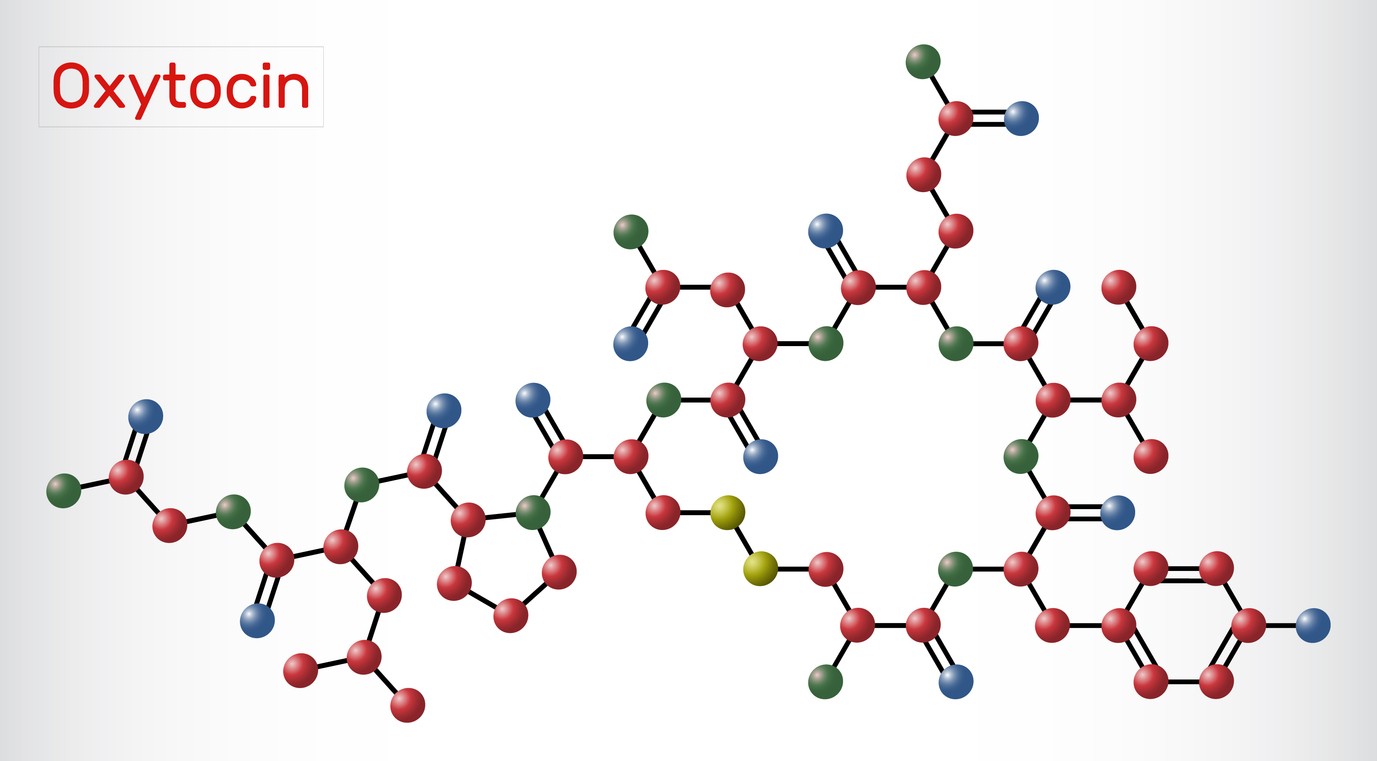
The amidated glycine and the disulfide-constrained ring are considered essential for receptor recognition, since reduction of the disulfide or removal of the C-terminal amide is posited to diminish biological activity greatly. Most laboratory work suggests that Oxytocin possibly exerts its actions by binding the oxytocin receptor (OXTR).
Potential laboratory research implications may include studying Oxytocin for its potential to probe OXTR signaling, receptor trafficking dynamics, calcium-dependent transcription, smooth-muscle excitability, osteoblast biology, and microglial inflammatory pathways in cell culture models.
Research
Oxytocin Affinity to the Oxytocin Receptor
Studies summarized by Gimpl and Fahrenholz suggest that Oxytocin’s main mechanism may involve high-affinity interaction with OXTR via the disulfide-constrained ring, with the Pro–Leu–Gly-NH2 tail apparently contributing to selectivity over the closely related vasopressin receptors.(1)
OXTR is posited to be a rhodopsin-family G protein–coupled receptor that appears to couple to multiple intracellular cascades, including Gαq/11–phospholipase C–IP3/Ca²⁺ and MAPK/ERK pathways. Additional studies have posited secondary actions involving β-arrestin recruitment, receptor internalization, and even nuclear trafficking of OXTR.
Oxytocin binding studies using radiolabeled and fluorescently labeled support a causal link between OXTR engagement of Oxytocin and downstream phospholipase C activation, IP3 generation, and a transient rise in intracellular Ca²⁺. Experiments have suggested no other potential receptors. Thus, it appears that Oxytocin’s bioactivity is mediated almost entirely through OXTR rather than other receptors or nonspecific membrane interactions.
Oxytocin Interactions with Mesolimbic Reward Circuit Mechanisms
Research in brain cell preparations has posited that Oxytocin may modulate components of the mesolimbic reward system, particularly the ventral tegmental area (VTA) and nucleus accumbens (NAc). A neuroanatomical study by Peris et al. suggests that OXTRs are expressed on a heterogeneous population of VTA neurons that project to neurons from the NAc, prefrontal cortex, and extended amygdala, with fewer than 10% of OXTR-expressing VTA neurons identified as dopaminergic (tyrosine hydroxylase–positive).(2)
Instead, the researchers commented that “almost 50% of OXTR-expressing cells in the VTA were glutamate (GLU) neurons, as indicated by expression of mRNA for the vesicular GLU transporter (vGluT).” This pattern is interpreted as indicating that Oxytocin may exert modulation of reward circuitry, also in part through glutamatergic neurons.
Work by Song et al. further suggests that intra-VTA oxytocin exposure may alter the temporal structure of social interaction in operant assays. In contrast, an OXTR antagonist apparently produced the opposite result.(3) The authors propose that VTA OXTR activation may be involved in the reinforcing properties of social stimuli in laboratory models.
Complementary work by Chang et al. using cell-type-specific DREADD manipulation suggests that paraventricular nucleus (PVN) oxytocin neurons may regulate the activity of a VTA-to-medial prefrontal cortex dopaminergic projection in models of social isolation.(4) Chemogenetic activation of PVN neurons by Oxytocin reportedly recapitulated isolation-associated changes in social behavior research models.
Additional research by Young et al. further posits that direct Oxytocin exposure to intramedial prefrontal cortex cells may restore pair-bonding patterns in research models in an OXTR-dependent manner, with associated changes in NAc dopamine levels.(5) hese findings are interpreted as data that oxytocin and dopamine systems within reward circuitry may interact at multiple anatomical nodes in experimental models.
Oxytocin Interactions with PVN Neurons in Mammalian Copulatory Function
Oxytocin is posited to hold research potential as a mediator in copulatory behavior in mammalian research models. Work by Argiolas and Melis suggests that oxytocinergic neurons in the PVN neurons may project to extrahypothalamic and spinal cord neurons, positioning them as potential key nodes in the central control of copulatory behavior in models of mammalian copulatory function.(6)
These neurons may potentially respond to other ligands such as dopamine, GABAergic, and opioid signals, which are posited to also play an important role in the regulation of copulatory function in mammalian research models. Specifically, the activation of the aforementioned oxytocinergic neurons in the PVN is posited to result in a downstream NO production, which in turn drives oxytocin release in downstream regions.
Furthermore, Argiolas and Melis. further suggests that Oxytocin exposure to the neurons from the PVN may activate downstream NO production via a cGMP-independent mechanism. In turn, the NO production is posited to drive oxytocin release in downstream regions, implying a self-reinforcing release loop.
Baskerville and Douglas add that dopamine receptors may be expressed directly on parvocellular oxytocin neurons from the PVN, making the dopamine–oxytocin axis a particularly well-defined circuit for probing the neurochemical coordination in lab models of mammalian copulatory function.(7) Specifically, they state that “The PVN provides the most convincing [data] for a dopamine-oxytocin link, and it is becoming increasingly apparent that parvocellular oxytocinergic neurons in the PVN, in part, mediate the [potential] of dopamine to elicit [arousal]” in mammalian research models.
Oxytocin Actions on Social Behavior Models via the VTA Neurons
Research by Groppe et al. using functional magnetic resonance imaging in research models posits that the VTA neurons may be the ones via which oxytocin may support the social behavior of mammalian research models.(8) The authors posit that oxytocin apparently better supports VTA activation in response to cues signaling either positive or negative social conditions. This pattern is often interpreted as data that indicates that OXTR engagement in midbrain neurons and reward nodes may bias the perceived salience of socially meaningful stimuli.
A separate functional imaging study by Greene et al. posits that oxytocin may differentially modulate mesocorticolimbic signaling responses to nonsocial versus social reward anticipation, with greater activation in neurons originating from the nucleus accumbens, anterior cingulate cortex, and orbitofrontal cortex during nonsocial reward anticipation under oxytocin relative to placebo.(9) The authors interpret these data as suggesting that OXTR engagement in reward circuitry is sensitive to stimulus category in experimental settings.
Oxytocin Interactions with Mammalian Amygdala Neurons in Fear Signaling Models
Research by Huber et al. suggests that oxytocin and vasopressin may modulate excitatory inputs into neurons from the central nucleus of the amygdala (CeA) in opposite directions, providing a putative cellular mechanism by which these neuropeptides shape fear signaling responses.(10) ecause the CeA neurons connect to brainstem and hypothalamic neurons that organize autonomic and behavioral fear responses, this opposing modulation is interpreted as a candidate node where neuropeptide signaling might bias the expression of defensive signaling in laboratory preparations.
Recent work reviewed by van den Burg et al. posits that oxytocin signaling in the central amygdala may not be limited to fear signaling regulation, but instead may regulate the selection of a wider range of signaling chains related to defensive responses in research models.(11) he authors note that the potential outcome of oxytocin signaling in neurons from the central amygdala apparently depends on the stress state of the research model, possibly explaining heterogeneous findings across laboratory studies. Thus, the data support a model in which oxytocin’s action in the amygdala is conditional and context-sensitive rather than uniformly positive in mechanistic research models.
NOTE: These products are intended for laboratory research use only. This peptide is not intended for personal use. Please review and adhere to our Terms and Conditions before ordering.
References:
- Gimpl G, Fahrenholz F. The oxytocin receptor system: structure, function, and regulation. Physiol Rev. 2001 Apr;81(2):629-83. 2001.81.2.629. PMID: 11274341.
- Peris J, MacFadyen K, Smith JA, de Kloet AD, Wang L, Krause EG. Oxytocin receptors are expressed on dopamine and glutamate neurons in the mouse ventral tegmental area that project to the nucleus accumbens and other mesolimbic targets. J Comp Neurol. 2017 Apr 1;525(5):1094-1108. doi: 10.1002/cne.24116. Epub 2016 Sep 27. PMID: 27615433; PMCID: PMC6483090.
- Borland JM, Grantham KN, Aiani LM, Frantz KJ, Albers HE. Role of oxytocin in the ventral tegmental area in social reinforcement. Psychoneuroendocrinology. 2018 Sep;95:128-137. doi: 10.1016/j.psyneuen.2018.05.028. Epub 2018 May 21. PMID: 29852406; PMCID: PMC6109598.
- Chang HT, Cheng KH, Hung YC, Hsu KS. Oxytocin signaling in the ventral tegmental area mediates social isolation-induced craving for social interaction. J Biomed Sci. 2025 Mar 17;32(1):37. doi: 10.1186/s12929-025-01130-0. PMID: 40098181; PMCID: PMC11912778.
- Young KA, Liu Y, Gobrogge KL, Wang H, Wang Z. Oxytocin reverses amphetamine-induced deficits in social bonding: evidence for an interaction with nucleus accumbens dopamine. J Neurosci. 2014 Jun 18;34(25):8499-506. doi: 10.1523/JNEUROSCI.4275-13.2014. PMID: 24948805; PMCID: PMC4061391.
- Argiolas A, Melis MR. The role of oxytocin and the paraventricular nucleus in the sexual behavior of male mammals. Physiol Behav. 2004 Nov 15;83(2):309-17. doi: 10.1016/j.physbeh.2004.08.019. PMID: 15488547.
- Baskerville TA, Douglas AJ. Interactions between dopamine and oxytocin in the control of sexual behavior. Prog Brain Res. 2008;170:277-90. PMID: 18655889. https://doi.org/10.1016/S0079-6123(08)00423-8
- Groppe SE, Gossen A, Rademacher L, Hahn A, Westphal L, Gründer G, Spreckelmeyer KN. Oxytocin influences the processing of socially relevant cues in the ventral tegmental area of the human brain. Biol Psychiatry. 2013 Aug 1;74(3):172-9. doi: 10.1016/j.biopsych.2012.12.023. Epub 2013 Feb 16. PMID: 23419544.
- Greene RK, Spanos M, Alderman C, Walsh E, Bizzell J, Mosner MG, Kinard JL, Stuber GD, Chandrasekhar T, Politte LC, Sikich L, Dichter GS. The effects of intranasal oxytocin on reward circuitry responses in children with autism spectrum disorder. J Neurodev Disord. 2018 Mar 27;10(1):12. doi: 10.1186/s11689-018-9228-y. PMID: 29587625; PMCID: PMC5870086.
- Huber D, Veinante P, Stoop R. Vasopressin and oxytocin excite distinct neuronal populations in the central amygdala. Science. 2005 Apr 8;308(5719):245-8. doi: 10.1126/science. 1105636. PMID: 15821089.
- van den Burg EH, Hegoburu C. Modulation of expression of fear by oxytocin signaling in the central amygdala: From reduction of fear to regulation of defensive behavior style. Neuropharmacology. 2020 Aug 15;173:108130. doi: 10.1016/j.neuropharm.2020.108130. Epub 2020 May 8. PMID: 32389750.