

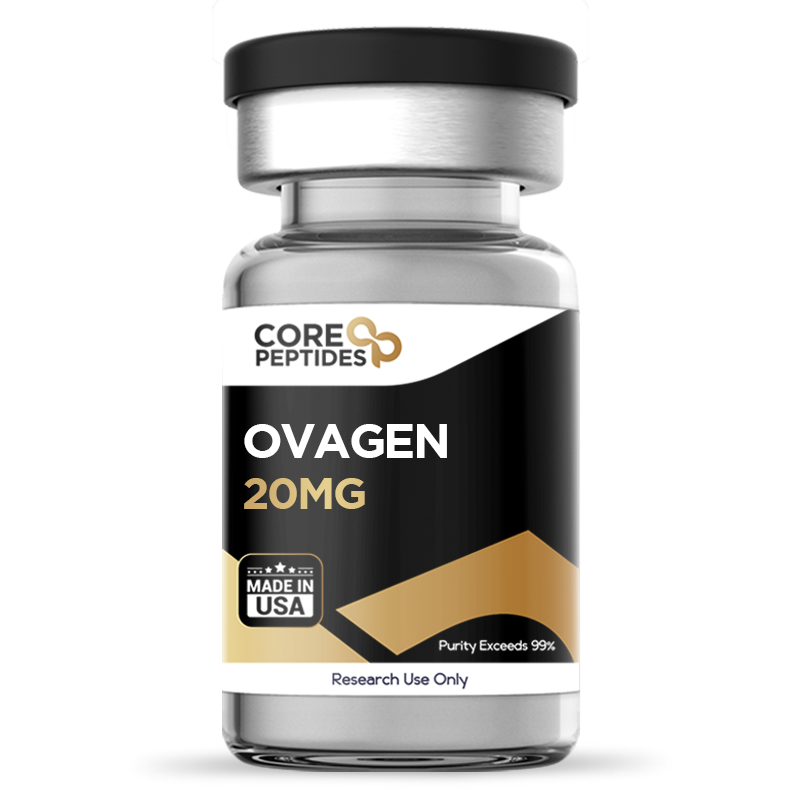
Ovagen (20mg)
$62.00
Size: 20mg
Contents: Ovagen
Form: Lyophilized powder
Purity: >99%
SKU: P-Ovagen
FREE Shipping on $200+ orders
Discount per Quantity
| Quantity | Discount | Price |
|---|---|---|
| 5 - 8 | 5% | $58.90 |
| 9 + | 10% | $55.80 |
Ovagen Peptide
Ovagen, also known by its sequence Glu–Asp–Leu (EDL), is classified among the short regulatory peptides that are proposed to act as genome-level bioregulators.(1) Within this conceptual framework, these compounds are often referred to as cytomedines, aka peptide messengers that may operate as independent signaling molecules, helping cells adapt their functional programs to internal and external cues. Within this broader family, Ovagen has been described by experts as a tripeptide that may form complexes with d(ATATATATAT )sequences located in the minor groove of DNA.
It is proposed that this peptide may bind preferentially to AT-rich stretches of mammalian DNA in the minor groove, where many regulatory interactions usually occur. Through these types of interactions, Ovagen is suggested to interact with the expression of genes encoding cellular aging markers and other regulators of cellular stress responses. In vitro data from renal and hepatic models further suggest that Ovagen may display protective potential, possibly by modulating gene expression programs linked to proliferation, redox balance, and cellular resilience.
Chemical Makeup
Other Known Titles: EDL; H-Glu-Asp-Leu-OH
Molecular Weight: 375.37 g/mol
Molecular Formula: C15H25N3O8
Research and Clinical Studies
Ovagen Research in Cellular Aging
Further research by Khavinson et al. describes Ovagen as having possible geroprotective actions on aging kidney (renal) cell cultures.(2) When added to both young and aged renal cells, Ovagen apparently increases cell proliferation while at the same time reducing the expression of several cellular aging-associated markers. Ovagen associates with specific AT-rich DNA regions, possibly modulating the transcription of genes related to p16, p21, p53, and SIRT6, and thereby may shift the balance of renal cells away from senescence and toward renewed proliferative capacity under in-vitro conditions.
These proteins are described in the paper as markers of cellular aging, so their downregulation in the presence of Ovagen may indicate a partial shift away from a senescent-like state toward a more proliferative phenotype. In parallel, Ovagen is reported to increase the expression of SIRT6 in renal cell cultures. Because the authors state that “the reduction of SIRT-6 synthesis in cells is one of the causes of cell senescence”, and the observed upregulation of SIRT6 in response to Ovagen is posited as a key element of its potential geroprotective activity at the cellular level. Taken together, within the limits of this single cell-culture study, Ovagen potential is described as a combination of better-supported proliferation, reduced expression of classical cellular aging markers, and increased expression of SIRT6.
Ovagen Research in Kidney Cells
Further research by Zamorskii et al in kidney cells suggests that Ovagen may induce a reduction in tubular water reabsorption by around 2.9% and a 1.6-fold rise in sodium excretion, while absolute and relative sodium reabsorption and proximal sodium transport remained stable.(3) The authors also noted that “EDL increased distal sodium transport by 1.2–1.3 times.” At the same time, the experiment by Zamorskii et al. reveals that the distal sodium transport apparently increased, and the correlations that describe glomerulo-tubular and tubular–tubular balance were preserved. Researchers such as these have suggested that Ovagen may shift distal tubular handling of sodium and water without disrupting intrinsic intrarenal autoregulation. Histological assessment after Ovagen exposure revealed no negative consequences in aged renal cells studied in laboratory settings.
The study also suggests that Ovagen may relevantly support the prooxidant–antioxidant balance in aged kidney cells. Ovagen was associated with reduced lipid peroxidation and a decrease in oxidatively modified proteins. At the same time, catalase and glutathione peroxidase activities both increased, with the rise in glutathione peroxidase activity being especially pronounced compared to control laboratory models. This pattern is posited as a potential attenuation of oxidative stress in renal cells. Thus, Ovagen may modestly support water and sodium excretion via tubular mechanisms, adjust distal sodium handling, and possibly dampen oxidative damage in kidney cells, all while apparently preserving normal intrarenal regulatory relationships and baseline histoarchitecture.
Ovagen Research in Liver Cells
Further experimental work, largely reported in the patent by Khavinson et al. and earlier liver-cell investigations, describes Ovagen as a tripeptide with potential hepatoregenerative and hepatoprotective actions under laboratory conditions.(4) In liver cell systems, Ovagen was observed to possibly prolong the survival of liver cells while at the same time stimulating the growth of neoplastic liver tissue, which the authors interpret as an indication of its capacity to modulate hepatic cell proliferation.
In parallel, murine models of liver regeneration after partial hepatectomy and experimental cirrhosis suggest that Ovagen apparently increases the proportion of dividing cells in regenerating liver tissue, may support biochemical markers associated with liver injury, and potentially increases hepatic glycogen content. Ovagen’s potential mechanisms behind these actions may involve interacting with genomic targets and thereby modulating the expression of genes that control proliferation, stress responses, and metabolic pathways in hepatic cells.
Ovagen peptide is available for research and laboratory purposes only. Please review our Terms and Conditions before ordering.
References:
- Khavinson, Vladimir Khatskelevich, et al. "Peptide regulation of gene expression: A systematic review." Molecules 26.22 (2021): 7053.
- Khavinson VKh, Tarnovskaia SI, Lin'kova NS, Poliakova VO, Durnova AO, Nichik TE, Kvetnoĭ IM, D'iakonov MM, Iakutseni PP. [Tripeptides slow down the aging process in renal cell culture]. Adv Gerontol. 2014;27(4):651-6. Russian. PMID: 25946838.
- Zamorskii, I. I.; Shchudrova, T. S.; Zeleniuk, V. G.; Linkova, N. S.; Nichik, T. E.; Khavinson, V. Kh. (2019). The Influence of Peptides on the Morphofunctional State of Kidneys in Old Rats. Advances in Gerontology, 9(1), 75–80. doi:10.1134/S207905701901017X
- Khavinson, Vladimir Khatskelevich, et al. "Пептид, стимулирующий регенерацию ткани печени, фармацевтическая композиция на его основе и способ ее применения." in Russian (2007).