


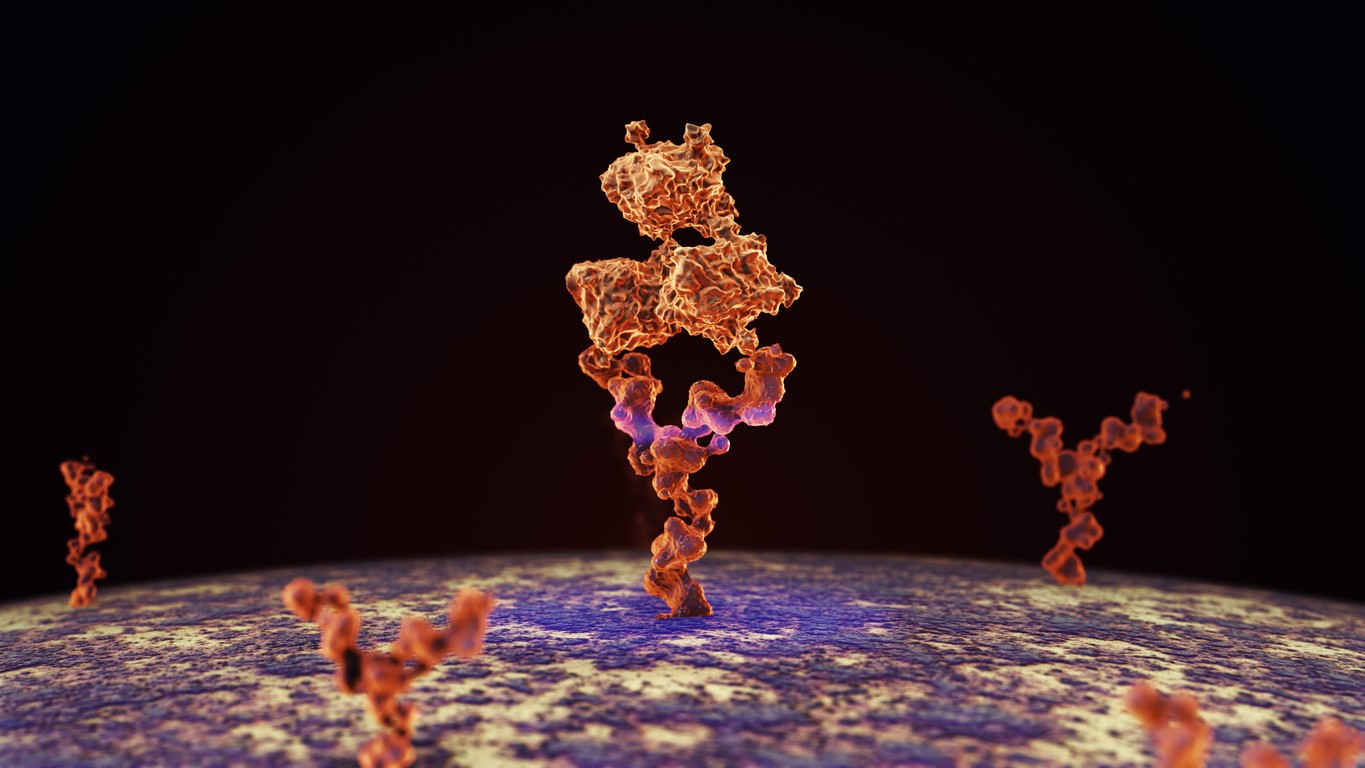
Sermorelin is a research peptide that appears to interact with growth hormone-releasing hormone (GHRH) receptors on pituitary cells. It’s made of 29 amino acids, which represent the shortest functional analog of growth hormone-releasing hormone, or GHRH, and may stimulate intracellular pathways associated with growth hormone (GH) synthesis and release.
Laboratory research suggests that these actions may also support downstream signaling involving the main anabolic mediator of GH, which is insulin-like growth factor 1 (IGF-1). However, the magnitude and duration of the observed responses appear to vary between research models. Below, we highlight the key mechanism involved in Sermorelin’s potential receptor interactions and stimulatory action on GH and IGF-1 synthesis via pituitary cells.
Sermorelin Structure and Stability
Sermorelin is a synthetic peptide composed of 29 amino acids corresponding to the first 29 residues of the larger 44-amino-acid GHRH sequence. Research by Clark et al. describes that Sermorelin is also amidated at the C-terminus, and it retains the functional activity associated with the N-terminal region of GHRH, suggesting that the first 29 residues may be sufficient for GHRH receptor recognition and activation.(1) The peptide may therefore be considered a shortened GHRH analog.
The C-terminal amidation is posited to support molecular stability, reduce susceptibility to some forms of enzymatic processing, and possibly help the shortened sequence maintain a receptor-compatible conformation. Thus, the peptide is also referred to as GRF(1–29)-NH₂ or GHRH(1–29)-NH₂.
Sermorelin Interactions with the GHRH-Receptor
The GHRH receptor, which appears to be the main target of Sermorelin, appears to be a class B G-protein-coupled receptor expressed on responsive pituitary cells. Research by Culhane et al. suggests that the peptide ligands may activate class B receptors through a two-domain process in which the ligand’s C-terminal region initially associates with the extracellular receptor domain, while its N-terminal region interacts with the juxtamembrane and transmembrane domains.(2) The authors explain that "such binding leads to conformational changes in the receptor's cytoplasmic domain to [activate] a G protein to trigger a downstream signaling process."
Further research by Halmos et al. suggests that the activated GHRH receptors may preferentially engage Gαs, which appears to function as a membrane-associated molecular switch connecting receptor activation with intracellular enzyme systems.(3) The receptor appears to recognize the peptide’s complete three-dimensional presentation rather than amino-acid composition alone. Consequently, changes in sequence, conformation, or peptide integrity may alter receptor affinity or the ability of receptor binding to produce a functional intracellular signal.
Following Sermorelin binding, Gαs may stimulate adenylyl cyclase and increase intracellular cyclic adenosine monophosphate, commonly abbreviated as cAMP. The increase in cAMP may then activate protein kinase A, or PKA, which may regulate downstream proteins through phosphorylation.
Sermorelin-associated cAMP signaling may also alter membrane excitability. Takei et al. suggest that cAMP and intracellular calcium may cooperate in the regulation of hormone secretion from pituitary-derived cells.(4) GHRH-receptor activation may promote depolarizing cation currents, which may subsequently favor the opening of voltage-dependent calcium channels.
The resulting rise in intracellular Ca²⁺ appears to serve as a proximal trigger for regulated exocytosis. Calcium may interact with the secretory machinery and promote the fusion of growth hormone-containing granules with the plasma membrane. This model suggests that receptor binding alone may not determine the final secretory output. Ion-channel activity, extracellular calcium availability, intracellular calcium handling, and the size of the release-ready granule pool may also support the observed response.
In addition to the immediate GH release upon receptor activation, Halmos et al. suggest that GHRH-receptor signaling may also activate cAMP-responsive transcriptional mechanisms, including pathways involving cAMP response element-binding protein.(3) These events may also support growth hormone gene expression and may support the quantity of growth hormone stored within responsive pituitary cells. A short exposure may primarily reflect release from preformed granules, whereas longer exposure to Sermorelin may also promote positive changes in the cells' potential for synthesis, storage, replenishment, and repeated release.
Sermorelin and Potential Growth Hormone Output from Pituitary Cells
Laboratory findings suggest that Sermorelin-related stimulation may increase growth hormone output from pituitary cells, although the apparent magnitude depends strongly on the observation period.
For example, Vittone et al. reported that mean growth hormone concentrations measured over 12 hours increased from approximately 1.1 ± 0.9 µg/L to around 2.2 ± 1.9 µg/L. The integrated 12-hour output also increased from roughly 1,114 ± 931 to approximately 2,032 ± 1,728 µg·min/L.(5) These observations suggest an approximately twofold increase across the complete 12-hour period. However, this longer measurement interval may combine an early high-amplitude response with later periods of regular or normal output, thereby reducing the apparent fold-change.
In contrast, research by Khorram et al. suggests that the most pronounced response to a modified Sermorelin-like sequence appeared to occur during the first two hours of experimental observation. The integrated growth hormone signal during this shorter interval increased from approximately 200–300 µg·L⁻¹·min to around 1,100–1,600 µg·L⁻¹·min, which is compatible with an approximately fivefold to sixfold early increase.(6)
The available findings therefore suggest that Sermorelin may produce a relatively short receptor-driven secretory burst rather than a continuously increasing signal. Outside this induced response, the underlying pulsatile pattern may remain comparatively preserved, suggesting that the peptide may add a receptor-mediated secretory event without completely reorganizing background activity. Repeated experimental evaluation has not consistently indicated marked desensitization.
Sermorelin and Downstream Anabolic Signaling
GH released from pituitary-cell models may function as an upstream signal for insulin-like growth factor 1, or IGF-1, in responsive laboratory systems. Khorram et al. reported that Sermorelin-related stimulation was accompanied by an apparent increase in IGF-1 of approximately 27–28%.(6) This observation suggests that even short receptor-driven growth hormone pulses due to repeated Sermorelin exposure may be sufficient to promote measurable downstream IGF-1 synthesis. Moreover, the authors comment that such an upregulation in IGF-1 synthesis may be linked to “increases in lean […] mass, insulin sensitivity…” and other potential actions.
Because IGF-1 is commonly described as a major mediator of growth hormone-associated anabolic signaling, an increase in its production may indicate that Sermorelin-driven pituitary signaling extends beyond the initial receptor-bearing cell population. This represents a potential indirect action, because Sermorelin appears to act primarily through GHRH receptors rather than through growth hormone or IGF-1 receptors.
Research discussed alongside Sermorelin-related IGF-1 signaling suggests that increased IGF-1 may also affect steroidogenic cell preparations. For example, Chatelain et al. reported that increased IGF-1 signaling appeared to increase the number of LH/hCG-binding sites and strengthen the acute steroidogenic response after hCG-receptor stimulation.(7) In the observed research model, hCG binding increased from approximately 2.5 to 5.6 fmol per gram. Following stimulation of the hCG-sensitive pathway, the testosterone readout increased from approximately 7.9 ng/mL in the control to around 25.2 ng/mL after increased IGF-1 signaling.
Frequently Asked Questions
What is Sermorelin and how is it related to GHRH?
Sermorelin is a synthetic peptide composed of 29 amino acids that correspond to the first 29 residues of the 44-amino-acid growth hormone-releasing hormone (GHRH) sequence. It is the shortest functional analog of GHRH identified to date, and it is amidated at the C-terminus, which is posited to support molecular stability and resistance to some forms of enzymatic processing. For this reason it is also referred to as GRF(1–29)-NH₂.
How may Sermorelin interact with the GHRH receptor?
The GHRH receptor appears to be a class B G-protein-coupled receptor expressed on responsive pituitary cells. Research suggests that peptide ligands activate class B receptors through a two-domain process, in which the C-terminal region first associates with the extracellular receptor domain while the N-terminal region interacts with the juxtamembrane and transmembrane domains. Activated receptors may preferentially engage Gαs, which may stimulate adenylyl cyclase, raise intracellular cAMP and activate protein kinase A.
What does research suggest about Sermorelin and growth hormone output?
Laboratory findings suggest that the apparent magnitude depends strongly on the observation period. Measured across 12 hours, mean growth hormone concentrations roughly doubled, whereas the most pronounced response to a modified Sermorelin-like sequence appeared within the first two hours and was compatible with an approximately fivefold to sixfold increase. The available findings therefore suggest a relatively short receptor-driven secretory burst rather than a continuously increasing signal, with the underlying pulsatile pattern comparatively preserved.
Is Sermorelin research associated with IGF-1?
Growth hormone released in responsive models may function as an upstream signal for insulin-like growth factor 1 (IGF-1). Sermorelin-related stimulation has been accompanied by an apparent increase in IGF-1 of approximately 27–28%, which suggests that even short receptor-driven growth hormone pulses may be sufficient to promote measurable downstream IGF-1 synthesis. This is considered a potential indirect action, because Sermorelin appears to act primarily through GHRH receptors rather than through growth hormone or IGF-1 receptors.
NOTE: These products are intended for laboratory research use only. This peptide is not intended for personal use. Please review and adhere to our Terms and Conditions before ordering.
References:
- Clark RG, Robinson ICAF. Growth induced by pulsatile infusion of an amidated fragment of human growth hormone releasing factor in normal and GHRF-deficient rats. Nature. 1985;314(6008):281–283. https://doi.org/10.1038/314281a0
- Culhane KJ, Liu Y, Cai Y, Yan ECY. Transmembrane signal transduction by peptide hormones via family B G protein-coupled receptors. Front Pharmacol. 2015;6:264. https://doi.org/10.3389/fphar.2015.00264
- Halmos G, Szabo Z, Dobos N, Juhasz E, Schally AV. Growth hormone-releasing hormone receptor (GHRH-R) and its signaling. Rev Endocr Metab Disord. 2025;26(3):343–352. https://doi.org/10.1007/s11154-025-09952-x
- Takei T, Yasufuku-Takano J, Takano K, Fujita T, Yamashita N. Effect of Ca2+ and cAMP on capacitance-measured hormone secretion in human GH-secreting adenoma cells. Am J Physiol. 1998;275(4):E649–E654. https://doi.org/10.1152/ajpendo.1998.275.4.E649
- Vittone J, Blackman MR, Busby-Whitehead J, et al. Effects of single nightly injections of growth hormone-releasing hormone (GHRH 1-29) in healthy elderly men. Metabolism. 1997;46(1):89–96. https://doi.org/10.1016/S0026-0495(97)90174-8
- Khorram O, Laughlin GA, Yen SSC. Endocrine and metabolic effects of long-term administration of [Nle27]growth hormone-releasing hormone-(1-29)-NH2 in age-advanced men and women. J Clin Endocrinol Metab. 1997;82(5):1472–1479. https://doi.org/10.1210/jcem.82.5.3943
- Chatelain PG, Sanchez P, Saez JM. Growth hormone and insulin-like growth factor I treatment increase testicular luteinizing hormone receptors and steroidogenic responsiveness of growth hormone deficient dwarf mice. Endocrinology. 1991;128(4):1857–1862. https://doi.org/10.1210/endo-128-4-1857