Tesamorelin – 5MG / 10MG
Price range: $43.00 through $79.00
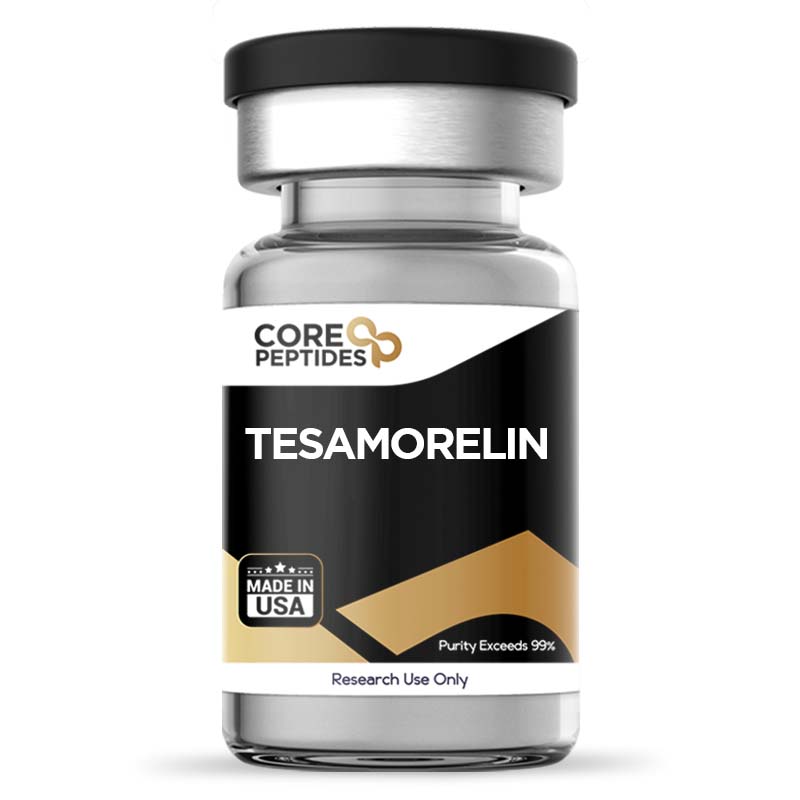
Tesamorelin is a 44-amino-acid GHRH analog with a modified N-terminus. Content size is 5mg or 10mg, in the form of lyophilized powder. Peptides are sold for laboratory research use only.
Purity: 99%+ by HPLC (third-party tested)
Tested by: Vanguard Laboratory, see Certificate of Analysis
SKU: P-TESAMRLN-5-10
Discount per Quantity
| Quantity | Discount | Price |
|---|
| 5 - 8 | 5% | Price range: $40.85 through $75.05 | |
| 9 + | 10% | Price range: $38.70 through $71.10 |
What Is Tesamorelin?
Tesamorelin is a synthetic polypeptide composed of 44 amino acids analogous to growth hormone-releasing hormone. The N-terminus of the compound has been modified compared to growth hormone-releasing hormone, the modification of which researchers suggest may lead to improved stability.(1)
Tesamorelin has been studied for its potential mechanism of action, posited to be similar to growth hormone-releasing hormones (GHRH) receptors located at the anterior pituitary gland, possibly leading to increased production and secretion of growth hormones. Growth hormones may act on several cells, including hepatocytes, stimulating the systemic synthesis of insulin-like growth factor-1 (IGF-1). In addition, growth hormone may also stimulate IGF-1 production locally, inside various tissues.(1)
How Is Tesamorelin Thought to Work?
IGF-1 has been posited to be the main anabolic mediator of growth hormone, potentially working to stimulate growth and inhibit programmed cell death.(1) On the other hand, growth hormone itself is suggested to be lipolytic, inducing fat breakdown at specific adipose depots, such as abdominal and visceral fat depositions. Tesamorelin appears to stimulate the release of growth hormone, and consequently IGF-1, by potentially interacting with the GHRH receptors in the anterior pituitary gland cells. When the peptide interacts with the GHRH receptor, it is hypothesized that this interaction might alter the receptor's structure, potentially initiating communication pathways within the cell. It is also theorized that the peptide might enhance the production of cyclic adenosine monophosphate (cAMP) in certain cells. This process may occur through the stimulation of adenylate cyclase, an enzyme that converts adenosine triphosphate (ATP) into cAMP. Increased cAMP levels may lead to the activation of protein kinase A (PKA), an enzyme deemed critical for transmitting signals within cells. Activated PKA may phosphorylate various target proteins, triggering a cascade of cellular responses. The conjectural stimulation of the GHRH receptor by Tesamorelin and the cAMP-PKA signaling pathway might promote the secretion and distribution of growth hormone (hGH) from somatotroph cells in the pituitary gland. Research indicates that this peptide may lead to an estimated 69% increase in overall growth hormone levels, measured by the area under the curve (AUC), and a reported 55% increase in the mean pulse area of the growth hormone. However, it does not seem to influence the frequency or peak levels of growth hormone pulses. Additionally, IGF-1 levels apparently surged by 122%.(3)
The N-terminus and C-terminus of the GHRH molecule are altered in Tesamorelin, potentially lending stability to the peptide and possibly increasing the compound's resistance to enzyme deactivation compared to natural GHRH.(4) Focusing on the specific alterations, the C-terminus of the peptide is modified by the addition of a trans-3-hexenoic acid group. This particular change, often referred to as an omega-amino acid modification, is believed to potentially reinforce the peptide's defense against enzymatic breakdown. On the other end, the N-terminus is modified by the attachment of an acetyl group, represented by the chemical notation CH₃CO-. This acetylation might enhance not only the molecule's stability but also its biological activity. As a result of these specific modifications, Tesamorelin is designated chemically as N-(trans-3-hexenoyl)-[Tyr1]hGRF(1–44)NH2 acetate, highlighting the specific alterations made to the peptide.
Specifications
| Name | Tesamorelin |
| Other known names | (3E)-hex-3-enoylsomatoliberin, TH9507 |
| Sequence | trans-3-hexenoyl-Tyr-Ala-Asp-Ala-Ile-Phe-Thr-Asn-Ser-Tyr-Arg-Lys-Val-Leu-Gly-Gln-Leu-Ser-Ala-Arg-Lys-Leu-Leu-Gln-Asp-Ile-Met-Ser-Arg-Gln-Gln-Gly-Glu-Ser-Asn-Gln-Glu-Arg-Gly-Ala-Arg-Ala-Arg-Leu-NH2 (44 amino acids) |
| Molecular formula | C221H366N72O67S |
| Molecular weight | 5136 g/mol |
| CAS number | 218949-48-5 |
| Synthesis | Solid-phase peptide synthesis, US |
| Form | Lyophilized powder |
| Amount per vial | 5 mg or 10 mg |
| Purity | >99% (HPLC) |
| Storage | −20 °C, dry, protected from light |
| SKU | P-TESAMRLN-5-10 |
What Does Research Show About Tesamorelin?
Does Tesamorelin Affect Lipodystrophy in Research Studies?
Key finding: In a pooled analysis of two placebo-controlled phase 3 trials, Tesamorelin reduced visceral adipose tissue compared with placebo.(6)
Lipodystrophy models refer to abnormal or pathological fat distribution and metabolism. The primary feature of lipodystrophy is the irregular distribution of fat into depots, leading to loss of fat (lipoatrophy) from specefic areas, and accumulation of excess fat (lipohypertrophy) in other regions. This abnormal fat distribution is often associated with serious negative metabolic changes, including insulin resistance, elevated cholesterol and triglyceride levels. Test models exhibiting lipodystrophy report low levels of GH and IGF-1. Researchers studying the peptide's action and potential impact, suggest that the peptide may positively influence lipid metabolism, especially in lipodystrophy models.
For example, two phase III studies(6) were conducted with 806 test subjects over 26 weeks, followed by another 26-week extension. Each of the 806 test subjects had immunodeficiencies and lipodystrophy. The subjects were divided into two groups; one group with 543 subjects was presented with Tesamorelin, and the remaining 263 subjects were presented with a placebo for 26 weeks. After this duration, the Tesamorelin subjects were again randomly divided into 2 groups, in which one group continued Tesamorelin influence, and the other half was presented with a placebo for another 26 weeks. At week 26, the researchers observed a significant decrease in visceral adipose tissue level amongst the Tesamorelin subjects, at least 15.4%. Additionally, the levels of triglyceride and cholesterol were reported significantly decreased compared to the placebo group.
What Does Research Show About Tesamorelin and Immunodeficient Fat Fractions?
Key finding: In a 12-month randomized, double-blind trial, Tesamorelin reduced hepatic fat fraction compared with placebo.(5)
Researchers posit that serious immunodeficiencies may induce non-alcoholic fatty liver disease (NAFLD), which in clinical cases is reported in nearly 40% of HIV-positive test models.(7) In this study,(5) 61 test subjects with HIV and a high hepatic fat fraction (HFF) were selected as test models. These subjects were influenced with Tesamorelin or a placebo for 12 months. The rate of HFF was monitored at the end of the study. After 12 months, it was reported by the researchers that 35% of subjects presented with Tesamorelin exhibited an apparent reduction in HFF rate by less than 5% vs. only 4% of subjects receiving placebo exhibited any HFF reduction. There was no reported alteration in the glucose levels.
What Does Research Show About Tesamorelin and Cognition?
In this clinical study,(8) immunodeficient models with mild cognitive impairment were observed. The main intent of this study was to determine the peptide's potential effect on neurological functioning. 100 subjects, aged more than 40 years, participated in this trial and underwent Tesamorelin presentation daily for 6 months, followed by all absence of Tesamorelin influence for the next 6 months. Then the peptide was re-introduced once a day for another 6 months. The primary outcome of this study was reported in changes in neurocognitive performance measured by the Global Deficit Score (GDS) after 6 and 12 months. This study is underway, and the final results have not been published.
Does Tesamorelin Affect Insulin Sensitivity in Research Studies?
Key finding: In a 12-week randomized, placebo-controlled trial in type 2 diabetes, Tesamorelin did not significantly change glycemic control.(9)
The main aim of this study(9) was to determine any potential the peptide might exhibit in altering insulin sensitivity. In this clinical trial setting, 53 test subjects with Type II diabetes were observed in this 12-week randomized trial. The subjects were divided into three groups, each receiving a lower or higher concentration of Tesamorelin or a placebo. Following the study period of 12 weeks, the concentration of fasting glucose, glycosylated hemoglobin, and diabetes control was measured. There was no reported significant reduction in either of these parameters. The results of all three groups appeared to be indifferent.
Does Tesamorelin Affect Muscle Tissue in Research Studies?
Key finding: In adults with HIV, Tesamorelin decreased muscle fat and increased muscle area.(10)
In a research investigation, the possible impacts of the peptide on the structural quality of muscle tissues were evaluated using computed tomography (CT) scans.(10) Computed tomography (CT) is an imaging tool that combines X-rays and computer technology to produce detailed pictures of internal structures. The findings from this study tentatively suggested a potential association between Tesamorelin and improvements in the density and overall volume of muscle tissues. It was observed that specific muscle groups, particularly the rectus abdominis, psoas major, and paraspinal muscles, exhibited more noticeable variations. These variations consisted of either increased muscle density and volume or decreased fat within the muscle tissue. From a statistical perspective, the alterations in muscle density and size or the reduction in fat content in these specific muscles were significantly different when compared to results from a control group receiving a placebo.
Does Tesamorelin Affect Visceral Fat in Research Studies?
Key finding: A review of the clinical trials reported that Tesamorelin significantly decreased waist circumference and visceral adipose tissue after 26 weeks.(2)
Visceral obesity involves the accumulation of excess fat around and within internal organs, a condition often observed in models of lipodystrophy—a disorder characterized by abnormal distribution of fat cells. This form of excessive fat accumulation is potentially linked to several metabolic issues. These issues include insulin resistance, a diminished ability to respond to insulin leading to elevated blood glucose levels. Additionally, visceral obesity is associated with the development of atherosclerosis, a condition where plaque builds up in the arteries, elevated levels of low-density lipoprotein (LDL) cholesterol, and hyperuricemia, an excess of uric acid. The significance of these models extends beyond aesthetic concerns, indicating that lipodystrophy may precipitate profound metabolic disturbances. In addressing these challenges, Tesamorelin, a synthetic form of the growth-hormone-releasing factor, has been proposed as a possibly positive avenue for further development. Research into the peptide has suggested it may lead to a reduction of up to 25% in visceral fat among lipodystrophy models.(11)
Certificate of Analysis
| Size | 5mg | 10mg |
| Batch / lot | C73525 | C73528 |
| Test date | 4/28/2026 | 4/28/2026 |
| Testing laboratory | Vanguard Laboratory | Vanguard Laboratory |
| Method | HPLC-UV/VIS (purity) | HPLC-UV/VIS (purity) |
| Purity result | >99.80% | >99.80% |
| Full report | Download the Tesamorelin 5mg COA (PDF) | Download the Tesamorelin 10mg COA (PDF) |
Tesamorelin peptide is available for research and laboratory purposes only. We offer free shipping in the US for orders over $200. Please review our Terms and Conditions before ordering.
Frequently Asked Questions
What is the molecular weight of Tesamorelin?
Tesamorelin has the molecular formula C221H366N72O67S and a molecular weight of approximately 5136 g/mol.
How does Tesamorelin differ from natural GHRH?
Tesamorelin is a 44-amino-acid analog of growth hormone-releasing hormone (GHRH) with a modified N-terminus, a change researchers suggest may improve its stability.
What is the CAS number of Tesamorelin?
The CAS number of Tesamorelin is 218949-48-5.
How should Tesamorelin be stored?
Lyophilized Tesamorelin should be stored at −20 °C, dry and protected from light.
Is Tesamorelin third-party tested?
Yes. The current batches (5mg: C73525; 10mg: C73528) were tested by a third-party laboratory and showed >99% purity by HPLC. Their certificates of analysis are available on this page.
References:
- National Institute of Diabetes and Digestive and Kidney Diseases. (2018). Tesamorelin. In LiverTox: Clinical and Research Information on Drug-Induced Liver Injury. Bethesda (MD). https://www.ncbi.nlm.nih.gov/books/NBK548730/
- Spooner, L. M., & Olin, J. L. (2012). Tesamorelin: a growth hormone-releasing factor analogue for HIV-associated lipodystrophy. The Annals of pharmacotherapy, 46(2), 240–247. https://doi.org/10.1345/aph.1q629
- Stanley, T. L., Chen, C. Y., Branch, K. L., Makimura, H., & Grinspoon, S. K. (2011). Effects of a growth hormone-releasing hormone analog on endogenous GH pulsatility and insulin sensitivity in healthy men. The Journal of clinical endocrinology and metabolism, 96(1), 150–158. https://doi.org/10.1210/jc.2010-1587
- Ferdinandi, E. S., Brazeau, P., High, K., Procter, B., Fennell, S., & Dubreuil, P. (2007). Non-clinical pharmacology and safety evaluation of TH9507, a human growth hormone-releasing factor analogue. Basic & clinical pharmacology & toxicology, 100(1), 49–58. https://doi.org/10.1111/j.1742-7843.2007.00008.x
- Stanley, T. L., Fourman, L. T., Feldpausch, M. N., Purdy, J., Zheng, I., Pan, C. S., Aepfelbacher, J., Buckless, C., Tsao, A., Kellogg, A., Branch, K., Lee, H., Liu, C. Y., Corey, K. E., Chung, R. T., Torriani, M., Kleiner, D. E., Hadigan, C. M., & Grinspoon, S. K. (2019). Effects of tesamorelin on non-alcoholic fatty liver disease in HIV: a randomised, double-blind, multicentre trial. The lancet. HIV, 6(12), e821–e830. https://doi.org/10.1016/s2352-3018(19)30338-8
- Falutz, J., Mamputu, J. C., Potvin, D., Moyle, G., Soulban, G., Loughrey, H., Marsolais, C., Turner, R., & Grinspoon, S. (2010). Effects of tesamorelin (TH9507), a growth hormone-releasing factor analog, in human immunodeficiency virus-infected patients with excess abdominal fat: a pooled analysis of two multicenter, double-blind placebo-controlled phase 3 trials with safety extension data. The Journal of clinical endocrinology and metabolism, 95(9), 4291–4304. https://doi.org/10.1210/jc.2010-0490
- ClinicalTrials.gov. Tesamorelin Effects on Liver Fat and Histology in HIV (NCT02196831). https://clinicaltrials.gov/study/NCT02196831
- ClinicalTrials.gov. Phase II Trial of Tesamorelin for Cognition in Aging HIV-Infected Persons (NCT02572323). https://clinicaltrials.gov/study/NCT02572323
- Clemmons, D. R., Miller, S., & Mamputu, J. C. (2017). Safety and metabolic effects of tesamorelin, a growth hormone-releasing factor analogue, in patients with type 2 diabetes: A randomized, placebo-controlled trial. PloS one, 12(6), e0179538. https://doi.org/10.1371/journal.pone.0179538
- Adrian, S., Scherzinger, A., Sanyal, A., Lake, J. E., Falutz, J., Dubé, M. P., Stanley, T., Grinspoon, S., Mamputu, J. C., Marsolais, C., Brown, T. T., & Erlandson, K. M. (2019). The Growth Hormone Releasing Hormone Analogue, Tesamorelin, Decreases Muscle Fat and Increases Muscle Area in Adults with HIV. The Journal of frailty & aging, 8(3), 154–159. https://doi.org/10.14283/jfa.2018.45
- Sivakumar, T., Mechanic, O., Fehmie, D. A., & Paul, B. (2011). Growth hormone axis treatments for HIV-associated lipodystrophy: a systematic review of placebo-controlled trials. HIV medicine, 12(8), 453–462. https://doi.org/10.1111/j.1468-1293.2010.00906.x
Related reading: Tesamorelin and the hypothalamic–pituitary–somatotropic axis and Tesamorelin research on anabolic and catabolic signaling.
Tesamorelin (5mg) – Certificate of Analysis

Tesamorelin (10mg) – Certificate of Analysis