


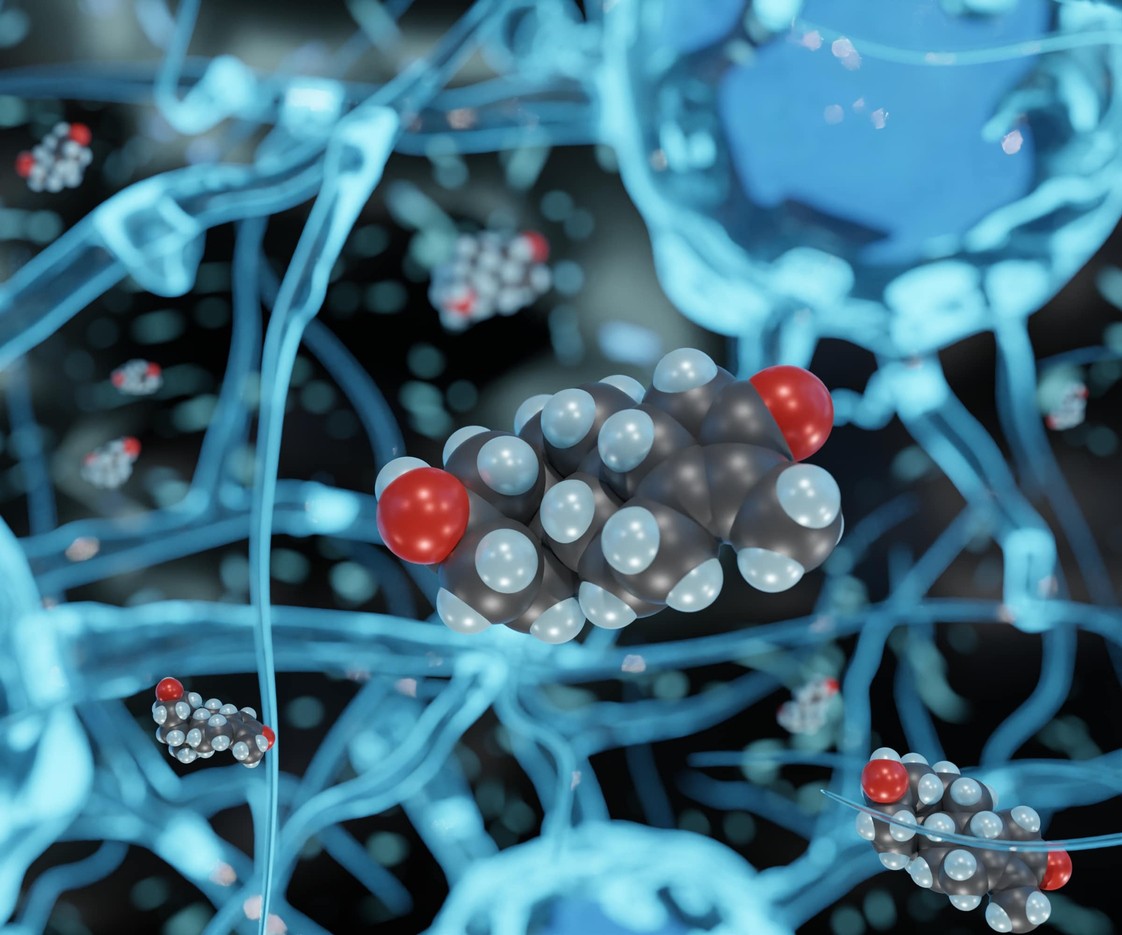
These alterations may make Tesamorelin peptide more potent and longer-lasting than the unmodified GHRH, promoting pulsatile release of endogenous growth hormone (GH) from pituitary cells and subsequent increases in anabolic mediators like insulin-like growth factor-1 (IGF-1) in other cells.
Research
Tesamorelin Structure
Tesamorelin is a molecule that mimics the 44-amino-acid sequence of GHRH but has specific modifications at the N-terminus and the C-terminus, which are posited to help reduce its breakdown and thus increase its half-life. Research by González-Sales et al. comments that the peptide may have a half-life of 25-40 minutes. Consequently, pituitary gland cells’ exposure to Tesamorelin may lead to an increase in growth hormone synthesis within 30-60 minutes.(1)
This half-life is considerably longer compared to the half-life of endogenous GHRH, which is considered to be 7-10 minutes. According to Ferdinandi et al., Tesamorelin may feature a trans-3-hexenoyl group attached to the terminal nitrogen of Tyr1 at the N-terminus. This modification appears to hinder dipeptidyl aminopeptidase-IV (DPP-IV) sterically, mitigating cleavage of the first two N-terminal amino acids (Tyr1-Ala2), which would otherwise rapidly deactivate Tesamorlein.(2) The C-terminus of Tesamorelin ends in -Leu44-CONH2, which appears to be an amidated form that may contribute to overall peptide stability but is secondary to N-terminal protection.
Tesamorelin Mechanisms
Research by Zhou et al. suggests that Tesamorelin apparently works by a specific mechanism that may involve binding to the growth hormone-releasing hormone receptors (GHRHRs).(3) These receptors are class B G-protein-coupled receptors, which may interact with Tesamorelin via an extensive network involving the extracellular domain, all extracellular loops, and multiple transmembrane helices except TM4.
The N-terminus (e.g., Tyr1, Asp3) may insert deeply into the transmembrane core, forming hydrogen bonds, salt bridges (e.g., Asp3P-K182^{2.67b}), and hydrophobic interactions that may stabilize the active conformation. Binding may induce extracellular domain extension, extracellular loop stabilization, and a TM6 outward kink at Pro^{6.47b}, opening the intracellular G-protein pocket for Gs coupling, elevating cAMP via adenylate cyclase.
Based on the data, triggering adenylate cyclase to increase cAMP may be followed by the activation of protein kinase A (PKA), and may lead to the exocytosis of growth hormone molecules via phosphorylation. Apparently, the molecular dynamics observed by the researchers confirm that extracellular domain flexibility aids this, while experiments with extracellular domain truncation appear to abolish signaling.
Tesamorelin Potential for Growth Hormone Synthesis
Research by Stanley et al. suggests that Tesamorelin may promote an “overall increase in GH secretion […] comprised of both increased basal GH secretion […] and increased average pulse area”.(4) Specifically, the peptide was suggested to apparently increase the mean overnight growth hormone synthesis from pituitary cells and 12-hour area under the curve (AUC) by 366 μg/L·h, equating to roughly a 69% overall rise.
This boost may stem from both the better-supported basal secretion and average growth hormone pulse area, which apparently rose by ~55% while preserving endogenous pulsatility. Specifically, there was no apparent change in the pulse frequency or half-life of the pituitary cells. Despite these increases in growth hormone levels and pulsatility, short-term experimentation of 2 weeks appeared to preserve the insulin sensitivity of other cells, even when assessed via euglycemic clamp M-value.
Tesamorelin and Downstream Anabolic Signaling
By upregulating growth hormone synthesis from pituitary cells, Tesamorelin may interact with the anabolic signaling in a variety of other cells. Notably, the growth hormone is considered to upregulate the production of a molecule called insulin-like growth factor-1 (IGF-1) in various peripheral cell populations. IGF-1 is considered one of the main anabolic signals to cells, as it may significantly upregulate cellular hypertrophy and proliferation.
According to the aforementioned research by Stanley et al., experimentation with Tesamorelin may upregulate IGF-1 levels markedly by ~122% from baseline, leading to an increase from ~148 μg/L to 181 μg/L.(4) This upregulation may reflect Tesamorelin’s potential stimulation of IGF-1 production in liver cells. Consequently, IGF-1 may promote protein synthesis, cell proliferation, and repair in fibroblasts, muscle cells, osteoblasts, chondrocytes, and tenocytes.
Moreover, the growth hormone may also stimulate IGF-1 production directly into other cells, such as muscle cells. Based on studies such as Makimura et al., this tissue-specific IGF-1 upregulation may trigger the canonical PI3K/Akt/mTOR signaling cascade that governs muscle cell hypertrophy and repair.(5)
Once produced inside the cells, the IGF-1 may bind to muscular IGF-1 receptors, recruiting and activating phosphoinositide 3-kinase (PI3K), which may generate PIP3 second messengers. Consequently, PIP3 may recruit Akt (PKB) to the membrane for PDK1/TORC2-mediated phosphorylation (Thr308/Ser473), yielding activated pAkt. In turn, pAkt may phosphorylate TSC2 (tuberin) at multiple sites (Ser939/Thr1462), mitigating the TSC1/2 complex and relieving mTORC1 suppression via Rheb-GTPase.
Consequently, mTORC1 may boost ribosomal biogenesis and translation initiation via 4E-BP1/eIF4E. Based on the research by other authors such as Yoshida et al., this may ultimately result in hypertrophy signaling, driving myofiber protein accretion for better-supported size, strength, and contractile function.(6)
Further laboratory validation comes from the research by Adrian et al., which suggests that Tesamorelin is associated with significant muscle cell density gains and lean area expansion reaching up to +12.1% baseline.(7) The authors posit that this may reflect true hypertrophy due to the thicker muscular tissue fibers plus better-supported muscle cell quality.
Tesamorelin and Downstream Catabolic Signaling
By upregulating growth hormone synthesis from pituitary cells, Tesamorelin may also have an interaction with catabolic signaling in some cells, specifically certain subpopulations of fat cells. Researchers such as Dehkhoda et al. suggest that the downstream upregulation of growth hormone synthesis may target specific types of fat cells, such as abdominal, also called visceral fat cells.(8) The authors commented that “GH [interacts with] adipose tissue in a depot-specific manner and [interacts with] other features of adipose tissue (for example, senescence, adipocyte subpopulations, and fibrosis)”.
The scientists posit that this regional selectivity may stem from a 2–3x higher growth hormone receptor density on visceral fat cells vs other types of fat cells, such as subcutaneous fat cells, thus enabling amplified signaling. The growth hormone binding may activate hormone-sensitive lipase (HSL) via PKA phosphorylation (Ser563/660) and adipose triglyceride lipase through CGI-58 recruitment, hydrolyzing triglycerides. This may lead to the release of free fatty acids and glycerol for β-oxidation export and energy production.
At the same time, the growth hormone may activate the JAK/STAT signaling pathway, turning on genes for fat-burning proteins like UCP1 for heat production, fat-release receptors, and fat-oxidation machinery, while blocking enzymes that store new fat. This may result in an average reduction of visceral fat cell volume by 15% according to the data.
Even if not burned for energy, the scientists posit that the released fatty acids from visceral fat cells may move to subcutaneous fat cells with better-supported insulin sensitivity, cutting harmful fat buildup in liver cells. Research by Machado et al. also suggests that lower visceral fat cell volume may lead to reduced fatty particle production, while at the same time, the higher growth hormone may upregulate LDL-clearing receptors on liver cells. This may lead to LDL cholesterol reduction by 5–10%, triglycerides reduction by 15–20%, and potentially raising HDL 5%.
NOTE: These products are intended for laboratory research use only. This peptide is not intended for personal use. Please review and adhere to our Terms and Conditions before ordering.
References:
- González-Sales, M., Barrière, O., Tremblay, P. O., Nekka, F., Mamputu, J. C., Boudreault, S., & Tanguay, M. (2015). Population pharmacokinetic and pharmacodynamic analysis of tesamorelin in HIV-infected patients and healthy subjects. Journal of pharmacokinetics and pharmacodynamics, 42(3), 287–299. https://doi.org/10.1007/s10928-015-9416-2
- Ferdinandi, E. S., Brazeau, P., High, K., Procter, B., Fennell, S., & Dubreuil, P. (2007). Non-clinical pharmacology and safety evaluation of TH9507, a human growth hormone-releasing factor analog. Basic & clinical pharmacology & toxicology, 100(1), 49–58. https://doi.org/10.1111/j.1742-7843.2007.00008.x
- Zhou, F., Zhang, H., Cong, Z., Zhao, L. H., Zhou, Q., Mao, C., Cheng, X., Shen, D. D., Cai, X., Ma, C., Wang, Y., Dai, A., Zhou, Y., Sun, W., Zhao, F., Zhao, S., Jiang, H., Jiang, Y., Yang, D., Eric Xu, H., … Wang, M. W. (2020). Structural basis for activation of the growth hormone-releasing hormone receptor. Nature communications, 11(1),
- Stanley TL, Chen CY, Branch KL, Makimura H, Grinspoon SK. Effects of a growth hormone-releasing hormone analog on endogenous GH pulsatility and insulin sensitivity in healthy men. J Clin Endocrinol Metab. 2011 Jan;96(1):150-8. doi: 10.1210/jc.2010-1587. Epub 2010 Oct 13. PMID: 20943777; PMCID: PMC3038486.
- Makimura, H., Murphy, C. A., Feldpausch, M. N., & Grinspoon, S. K. (2014). The effects of tesamorelin on phosphocreatine recovery in obese subjects with reduced GH. The Journal of clinical endocrinology and metabolism, 99(1), 338–343. https://doi.org/10.1210/jc.2013-3436
- Yoshida, T., & Delafontaine, P. (2020). Mechanisms of IGF-1-Mediated Regulation of Skeletal Muscle Hypertrophy and Atrophy. Cells, 9(9), 1970. https://doi.org/10.3390/cells9091970
- Adrian, S., Scherzinger, A., Sanyal, A., Lake, J. E., Falutz, J., Dubé, M. P., Stanley, T., Grinspoon, S., Mamputu, J. C., Marsolais, C., Brown, T. T., & Erlandson, K. M. (2019). The Growth Hormone Releasing Hormone Analog, Tesamorelin, Decreases Muscle Fat and Increases Muscle Area in Adults with HIV. The Journal of frailty & aging, 8(3), 154–159. https://doi.org/10.14283/jfa.2018.45
- Dehkhoda, F., Lee, C. M. M., Medina, J., & Brooks, A. J. (2018). The Growth Hormone Receptor: Mechanism of Receptor Activation, Cell Signaling, and Physiological Aspects. Frontiers in endocrinology, 9, 35. https://doi.org/10.3389/fendo.2018.00035
- Machado, M. O., Hirata, R. D., Hirata, M. H., Hirszel, P., Sellitti, D. F., & Doi, S. Q. (2003). Growth hormone increases low-density lipoprotein receptor and HMG-CoA reductase mRNA expression in mesangial cells. Nephron. Experimental nephrology, 93(4), e134–e140. https://doi.org/10.1159/000070237