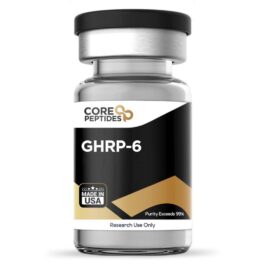


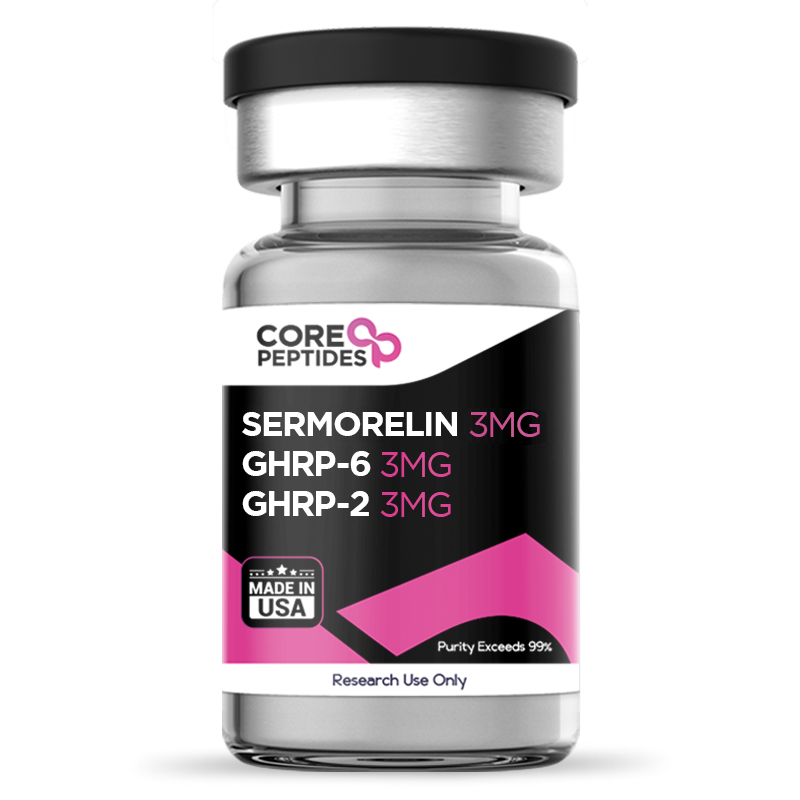
Sermorelin & GHRP-6 & GHRP-2 Blend (9mg)
$85.00
Size: 9mg
Contents: Sermorelin (3mg) & GHRP-6 (3mg) & GHRP-2 (3mg)
Form: Lyophilized powder
Purity: >99%
SKU: Sermorelin-GHRP-6-GHRP-2-9mg
FREE Shipping on $200+ orders
Discount per Quantity
| Quantity | 5 - 8 | 9 + |
|---|---|---|
| Discount | 5% | 10% |
| Price | $80.75 | $76.50 |
Sermorelin & GHRP-2 & GHRP-6 Blend
Blending the peptides Sermorelin, GHRP-2, and GHRP-6 may be practical for researchers aiming to investigate the potential of stimulating pituitary cells (somatotrophs) via multiple pathways. Specifically, these three peptides appear to interact with pituitary cells via different receptors.
Sermorelin is a research peptide made of 29 amino acids that is a shortened version of the endogenous 44 amino acid structure of Growth Hormone-Releasing Hormone (GHRH). Similar to its endogenous counterpart, Sermorelin appears to interact with the cells via the GHRH-receptor, which is also considered the main receptor for stimulating growth hormone (hGH) release from the pituitary cells.
GHRP-2 and GHRP-6 are fully synthetic peptides that are posited as growth hormone secretagogues (GHSs) as they appear to interact with another set of receptors on the somatotrophs. Specifically, those are the growth hormone secretagogue receptors type 1a (GHS-R1a), which also respond to the hormone ghrelin. Despite sharing no homology with ghrelin, GHRP-2 and GHRP-6 appear to reliably activate the GHS-R1a and also stimulate hGH release from the pituitary cells. Several experiments suggest that simultaneously activating the GHS-R1a and GHRH receptors may produce combined and synergistic actions.
Chemical Makeup
Other Known Titles
- Sermorelin: GRF 1-29 NH2
- GHRP-2: pralmorelin
- GHRP-6: SKF-110679, growth hormone-releasing hexapeptide
Molecular Weight:
- Sermorelin: 93 g/mol
- GHRP-2: 97 g/mol
- GHRP-6: 03 g/mol
Molecular Formula:
- Sermorelin: C149H246N44O42S
- GHRP-2: C45H55N9O6
- GHRP-6: C46H56N12O6
Research and Clinical Studies
Sermorelin & GHRP-2 & GHRP-6 Receptor Interactions
According to research by Clark et al., Sermorelin appears to interact with the GHRH receptors.(1) This is allowed by its structure as it is the shortest functional analog of endogenous GHRH with a C-terminal amidation that may help stabilize the molecule. According to studies by Culhane et al., it appears to activate the GHRH receptors through several steps, which may involve the activation of an intracellular messenger called cyclic AMP (cAMP) and the kinase PKA (protein kinase A), which together may switch on the cellular machinery that synthesizes and releases hGH.(2) There does not appear to be desensitization according to the available laboratory research. The resulting hGH synthesis may have direct and indirect actions. The indirect may be via its anabolic mediator IGF-1 (insulin-like growth factor-1), which is produced in other tissue cells when they are presented with hGH.
GHRP-2 and GHRP-6 appear to interact with the GHS-R1a, also referred to as the ghrelin receptors. However, these two hexapeptides have no similarities with ghrelin in terms of structure, as highlighted by the work of Bowers et al in 2012.(3) Furthermore, laboratory research by Yin et al. suggests that they may exert a chain of intracellular cascades and events in somatotrophs by interacting with these receptors.
Researchers posit that GHRP-2 and GHRP-6 may activate the receptors by interacting with the enzyme phospholipase C (PLC), which cuts a specific membrane molecule (PIP₂) into two smaller signaling molecules called IP₃ and DAG. The latter may help switch on another enzyme family called protein kinase C (PKC), which is posited to interact with protein synthesis related to hGH synthesis. On the other hand, IP₃ appears to interact with the internal calcium stores of pituitary cells, causing Ca²⁺ to be released into the cytoplasm, which may then release hGH molecules out of the pituitary cells.
Sermorelin & GHRP-2 & GHRP-6 and hGH Synthesis
Laboratory work in pituitary cell models suggests that exposing somatotrophs to Sermorelin may upregulate hGH synthesis, although the specific action size varies between studies. For example, in an experiment reported by Vittone et al., the mean 12-hour growth hormone concentrations were described as rising about 2-fold from about 1.1 ± 0.9 µg/L to roughly 2.2 ± 1.9 µg/L.(5) The cumulative hGH output for these 12 hours also appeared to increase 2-fold, from around 1,114 ± 931 to about 2,032 ± 1,728 µg·min/L. Additional work by Khorram et al. suggests that the increase may particularly occur during the first 2 hours of exposure, while longer windows may blend early peaks with later, lower-amplitude release.(6) They employed a slightly modified Sermorelin molecule. They described that the 2-hour integrated growth hormone signal appeared to shift from roughly 200–300 to about 1,100–1,600 µg·L⁻¹·min, which is close to a sixfold rise.
GHRP-2 and GHRP-6 also appear to induce short-term peaks in hGH levels. For example, older research by Bowers et al. from 2004 suggests that under continuous 24-hour evaluation, GHRP-2 may also increase growth hormone production from approximately 20–30 µg·L⁻¹·24 h in placebo controls to about 120–180 µg·L⁻¹·24 h with GHRP-2, suggesting an estimated 4- to 6-fold increase. On the other hand, research by Micic et al. investigated peak growth hormone responses of pituitary cells after stimulation with GHRP-6 and reportedly observed a rise from basal 1–2 mU/L to around 60 mU/L.(8) Based on this data, the peptide may induce peaks that exceed 3-fold the typical physiological peaks that may reach about 20 mU/L. Indeed, the researchers also commented that “GH responses to GHRP-6 are much greater than to GHRH”.
Sermorelin & GHRP-2 & GHRP-6 and Anabolic Signaling
Based on the aforementioned publications by Khorram et al. and the research by Bowers et al., from 2004 suggest that the peptides may induce a significant stimulation of hGH synthesis in pituitary cells that may then prove to be sufficient to induce IGF-1 synthesis in nearby cell cultures.(6)(7) More specifically, Khorram et al. suggested that there has been about a 27–28% increase in IGF-1 synthesis following Sermorelin experimentation. With the GHRP-2 exposure for 24 hours, Bowers et al. suggested that the IGF-1 levels may have increased from 90–100 µg/L to approximately 150–160 µg/L, which is equal to roughly a 50–80% increase. Unfortunately, the GHRP-6 experiment by Micic et al. was too short to report any data on IGF-1 synthesis.(8)
Sermorelin & GHRP-2 & GHRP-6 and Synergistic Actions
Blending Sermorelin with GHRP-2 and GHRP-6 is often framed as a practical way to evaluate dual-receptor stimulation in somatotroph systems. When both receptor families are activated at the same time, several experimental datasets suggest that growth hormone output may rise beyond what is seen with either pathway alone, which is compatible with additive or synergistic coupling at the level of pituitary signaling.
Unfortunately, most of the experiments have evaluated GHRP-2 or GHRP-6 with full-length GHRH rather than Sermorelin, but such results are valuable for future research. For example, the pituitary models described by Micic et al. reveal that GHRP-6 alone was associated with a peak growth hormone response around 60 mU/L, while the combination of GHRP-6 with full-length GHRH was reported to raise the peak to roughly 140 mU/L, or 7-fold higher than the highest physiological peaks.(8) Cordido et al. also suggested that GHRP-6 alone produced an average peak around 6 mU/L, while the GHRH analogue alone produced a smaller peak near 2.6 mU/L. When both secretagogues were applied together, the peak rose to about 16.3 mU/L. Their integrated 12-hour data followed the same direction. The reported 12-hour growth hormone exposure was around 260 mU·min/L with GHRP-6 alone and about 159 mU·min/L with the GHRH analogue alone, but increased to roughly 729 mU·min/L when the two were combined.(9)
Comparable synergy signals have been reported for GHRP-2 when combined with endogenous, full-length GHRH in experimental pituitary systems. In the work by Veldhuis et al., each peptide produced a large outcome on its own. However, the combination still yielded an extra increment. (10) In their models, GHRH alone was estimated to raise growth hormone burst output by roughly 20-fold over baseline. At the same time, GHRP-2 alone was associated with an even larger rise, around 47-fold. When both stimuli were present, the calculated response increased to about 54-fold above saline, which corresponds to a modest additional gain over GHRP-2 alone. The aforementioned 2004 research on GHRP-2 by Bowers et al. also included GHRH co-evaluation and concluded that the “combined GHRP-2 and GHRH drive is more effective than either agonist alone.””
Currently, only the research by Sigalos et al. evaluated a combination of Sermorelin with both GHRP-2 and GHRP-6.(11) Their findings suggest an upward shift in IGF-1 from baseline values around 160 ng/mL to roughly 250–265 ng/mL, which corresponds to an apparent 1.6-fold increase. Because the design involved multiple peptides and did not isolate each contribution, the data do not map cleanly onto a single receptor-pair interaction. Still, the direction of change is compatible with the broader observation that GHRH-receptor input and GHS-R1a input may cooperate to increase downstream hGH output.
BSermorelin & GHRP-2 & GHRP-6 blend is available for research and laboratory purposes only. Please review our Terms and Conditions before ordering.
References:
- Clark RG, Robinson IC. Growth induced by pulsatile infusion of an amidated fragment of hGH-releasing factor in normal and GHRF-deficient rats. Nature. 1985 Mar 21-27;314(6008):281-3. doi: 10.1038/314281a0. PMID: 2858818.
- Culhane KJ, Liu Y, Cai Y, Yan EC. Transmembrane signal transduction by peptide hormones via family B G protein-coupled receptors. Front Pharmacol. 2015 Nov 5;6:264. doi: 10.3389/fphar.2015.00264. PMID: 26594176; PMCID: PMC4633518.
- Bowers CY. History of the discovery of ghrelin. Methods Enzymol. 2012;514:3-32. PMID: 22975043. https://doi.org/10.1016/B978-0-12-381272-8.00001-5
- Yin Y, Li Y, Zhang W. The growth hormone secretagogue receptor: its intracellular signaling and regulation. Int J Mol Sci. 2014 Mar 19;15(3):4837-55. doi: 10.3390/ijms15034837. PMID: 24651458; PMCID: PMC3975427.
- Vittone J, Blackman MR, Busby-Whitehead J, Tsiao C, Stewart KJ, Tobin J, Stevens T, Bellantoni MF, Rogers MA, Baumann G, Roth J, Harman SM, Spencer RG. Effects of single nightly injections of growth hormone-releasing hormone (GHRH 1-29) in healthy elderly men. Metabolism. 1997 Jan;46(1):89-96. doi: 10.1016/s0026-0495(97)90174-8. PMID: 9005976.
- Khorram O, Laughlin GA, Yen SS. Endocrine and metabolic effects of long-term administration of [Nle27]growth hormone-releasing hormone-(1-29)-NH2 in age-advanced men and women. J Clin Endocrinol Metab. 1997 May;82(5):1472-9. doi: 10.1210/jcem.82.5.3943. PMID: 9141536.
- Bowers, C. Y., Granda, R., Mohan, S., Kuipers, J., Baylink, D., & Veldhuis, J. D. (2004). Sustained elevation of pulsatile growth hormone (GH) secretion and insulin-like growth factor I (IGF-I), IGF-binding protein-3 (IGFBP-3), and IGFBP-5 concentrations during 30-day continuous subcutaneous infusion of GH-releasing peptide-2 in older men and women. The Journal of clinical endocrinology and metabolism, 89(5), 2290–2300. https://doi.org/10.1210/jc.2003-031799
- Micic D, Popovic V, Kendereski A, Macut D, Casanueva FF, Dieguez C. Growth hormone secretion after the administration of GHRP-6 or GHRH combined with GHRP-6 does not decline in late adulthood. Clin Endocrinol (Oxf). 1995 Feb;42(2):191-4. doi: 10.1111/j.1365-2265.1995.tb01861.x. PMID: 7734029.
- Cordido F, Peñalva A, Dieguez C, Casanueva FF. Massive growth hormone (GH) discharge in obese subjects after the combined administration of GH-releasing hormone and GHRP-6: evidence for a marked somatotroph secretory capability in obesity. J Clin Endocrinol Metab. 1993 Apr;76(4):819-23. doi: 10.1210/jcem.76.4.8473389. PMID: 8473389.
- Veldhuis JD, Keenan DM. Secretagogues govern GH secretory-burst waveform and mass in healthy eugonadal and short-term hypogonadal men. Eur J Endocrinol. 2008 Nov;159(5):547-54. doi: 10.1530/EJE-08-0414. Epub 2008 Aug 14. Erratum in: Eur J Endocrinol. 2008 Dec;159(6):841. PMID: 18703567; PMCID: PMC2680123.
- Sigalos JT, Pastuszak AW, Allison A, Ohlander SJ, Herati A, Lindgren MC, Lipshultz LI. Growth Hormone Secretagogue Treatment in Hypogonadal Men Raises Serum Insulin-Like Growth Factor-1 Levels. Am J Mens Health. 2017 Nov;11(6):1752-1757. doi: 10.1177/1557988317718662. Epub 2017 Aug 22. PMID: 28830317; PMCID: PMC5675260.