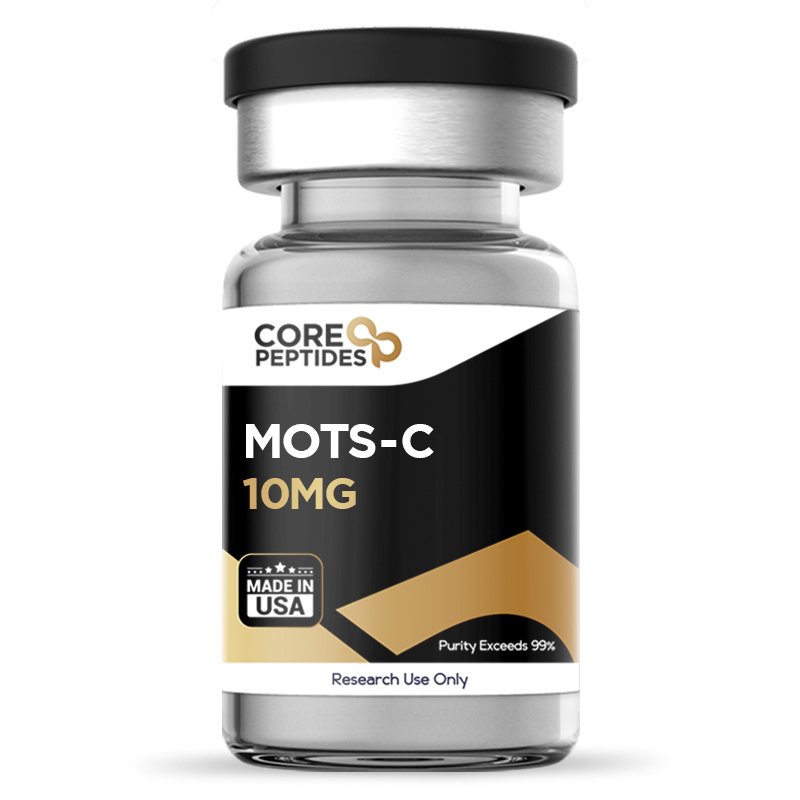
MOTS-C – 10MG
$116.00
MOTS-c is a 16-amino-acid mitochondrial-derived peptide encoded in the 12S rRNA region. Content size is 10mg, in the form of lyophilized powder. Peptides are sold for laboratory research use only.
Purity: 99%+ by HPLC (third-party tested)
Tested by: Vanguard Laboratory, see Certificate of Analysis
SKU: P-MOTS-C-10mg
Discount per Quantity
| Quantity | Discount | Price |
|---|
| 5 - 8 | 5% | $110.20 | |
| 9 + | 10% | $104.40 |
What Is MOTS-c?
MOTS-c (mitochondrial open-reading-frame of the 12S rRNA-c) peptide is a novel mitochondria-derived peptide. It is a short peptide composed of 16 amino acids, expressed in tissues and plasma, indicating a cell-specific and hormonal role.(1) With the potential to work both as a cell-specific compound and as a hormone, this peptide possibly acts by stimulating the AMP-activated protein kinase (AMPK) pathway. Humanin and MOTS-c are the best-studied mitochondrial-derived peptides (MDPs). When metabolic stress occurs in the organism, the peptide is believed to translocate to the cellular nuclei and alter the gene expression. The peptide may also be released extracellularly and is known as "mitochondrial hormone" or simply as "mitokine.”(2)(3)
Specifications
| Name | MOTS-c (Mitochondrial open reading frame of the 12S rRNA-c) |
| Other known names | Mitochondrial-derived peptide MOTS-c |
| Sequence | Met-Arg-Trp-Gln-Glu-Met-Gly-Tyr-Ile-Phe-Tyr-Pro-Arg-Lys-Leu-Arg (MRWQEMGYIFYPRKLR) |
| Molecular formula | C101H152N28O22S2 |
| Molecular weight | 2174.64 g/mol |
| CAS number | 1627580-64-6 |
| Synthesis | Solid-phase peptide synthesis, US |
| Form | Lyophilized powder |
| Amount per vial | 10 mg |
| Purity | >99% (HPLC) |
| Storage | −20 °C, dry, protected from light |
| SKU | P-MOTS-C-10mg |
What Does Research Show About MOTS-c?
Animal research models have indicated multiple potential actions from the peptide, including increased physical performance, regulated cellular and tissue metabolism, and myoblast adaptation.(2) Research suggests that these actions may primarily depend on age and age-related changes in MOTS-c expression. The researchers suggest the peptide's levels and activity might decline, hinting at a role in the cell aging process and the development of age-related metabolic dysfunction. Furthermore, the peptide may interact with known aging regulators, such as NAD+ and sirtuins, suggesting its involvement in pathways potentially modulating the lifespan of the cell.(1) As per Joseph C Reynolds et al., “Mitochondria are chief metabolic organelles with strong implications in cell aging that also coordinate broad physiological functions, in part, using peptides that are encoded within their independent genome.”(5) The peptide endogenous expression has also been posited to be boosted via physical activity, potentially enhancing cellular metabolism.
Does MOTS-c Affect Muscle Metabolism in Research Models?
Key finding: In aged mice, late-life intermittent MOTS-c exposure increased physical capacity and healthspan.(5)
With increasing age, skeletal muscles tend to gain insulin resistance, leading to decreased glucose uptake. Upon peptide exposure, skeletal muscles may be stimulated with an improved response toward AMPK activation. As a result, glucose transporter expression may increase, potentially improving skeletal muscle metabolism and enhancing skeletal muscle functioning and growth. Further, the peptide's actions are posited to include targeting metabolic pathways such as the folate-methionine cycle and purine biosynthesis. This targeting may potentially lead to a modulation of cellular metabolism, including actions on glucose uptake and lipid utilization. The peptide's impact might involve a shift in metabolic priorities within the cell, possibly affecting the balance between anabolic and catabolic processes. In systemic metabolism, the peptide is posited to function as a mitochondrial hormone, with circulating peptide levels appearing to affect metabolic functions in skeletal muscle and possibly adipose tissue. Its potential regulatory actions on glucose homeostasis and insulin action suggest a broader hormonal role in energy balance and nutrient sensing across different tissues.(1)
Does MOTS-c Affect Fat Cell Metabolism in Research Models?
Key finding: In ovariectomized mice, MOTS-c regulated adipose tissue homeostasis and prevented ovariectomy-induced metabolic dysfunction.(4)
Research has suggested that the peptide may potentially leave the mitochondrial site, translocate to cellular nuclei, and possibly alter gene expression. More specifically, the peptide may interact with a broad range of genes, particularly those with antioxidant response elements (ARE), hinting at a potential regulatory relationship with stress-responsive transcription factors like NRF2. Such findings suggest a genetically integrated system of mitonuclear communication, where both mitochondrial and nuclear genomes may encode factors that cross-regulate each other. This action, in turn, may alter glucose uptake restriction.(6) This hypothesis was first suggested from a study in which the experimental mice were given high-fat food, and only half were presented with the peptide. The researchers indicated that the peptide may potentially impact cellular metabolism by inhibiting the folate cycle directly tethered de novo purine biosynthesis, consequently leading to AMPK activation. Such actions hint at a broader role of the peptide in regulating insulin sensitivity and metabolic homeostasis, offering insights into its preventive potential against age-dependent and high-fat-induced insulin resistance and diet-induced obesity. The study presents supportive data to suggest that the peptide may stimulate glucose utilization, affect the methionine-folate cycle, and promote AMPK activation. These cellular actions suggest that the peptide might coordinate various metabolic processes, including glucose and lipid metabolism. Consequently, the murine models exposed to the peptide were lean and more energetic than the rest, further indicating that the peptide might prevent fat accumulation and induce glucose uptake via the AMPK pathway.(3)
Does MOTS-c Affect Bone in Laboratory Studies?
Key finding: In bone marrow mesenchymal stem cells, MOTS-c promoted osteogenic differentiation through the TGF-β/Smad pathway.(7)
The peptide has been suggested to regulate the transforming growth factor beta (TGF-beta)/SMAD pathway, which may profoundly affect bone tissues.(7) More specifically, its actions may involve the upregulation of TGF-β/Smad pathway-related genes, including TGF-β1, TGF-β2, and Smad7, suggesting a pivotal role of this pathway in MOTS-c mediated osteogenic differentiation. This hypothesis is further supported when the osteogenic differentiation promoted by MOTS-c is reversed upon TGF-β1 knockdown, indicating that the peptide's actions may be at least partly mediated through the TGF-β/Smad pathway. The peptide may also stimulate the expression of osteogenesis-related genes such as ALP, Bglap, and Runx2. Thus, this peptide may stimulate the SMAD pathway in the osteoblast cells, possibly improving bone density and strength. When studied in bone marrow cells, this compound appeared to trigger the differentiation of the stem cells, which may lead to bone tissue development.
What Does Research Show About MOTS-c and Cardiac Function?
Key finding: In 40 models of coronary angiography, plasma levels of the peptide were lower in those with coronary endothelial dysfunction.(8)
The peptide has not been suggested by researchers to directly influence cardiac function; instead, researchers posit that the peptide exerts potential on the endothelial cells that line the blood vessels inside. These endothelial tissues are considered to affect blood pressure and clotting. The researchers suspect a positive correlation exists between MOTS-c levels and microvascular and epicardial endothelial function. Such findings tentatively suggest MOTS-c as a potential biomarker for endothelial function, with the study revealing a nuanced relationship between MOTS-c levels and vascular reactivity. Further, the research suggested that when mice were exposed to the peptide, it appeared to improve the endothelial tissues' functioning, thereby possibly counteracting dysfunction. The mechanistic basis for the peptide's action on endothelial function remains speculative but may involve the activation of AMPK.(8)
What Does Research Show About MOTS-c and Cell Lifespan?
Key finding: In one study, researchers proposed a link between exceptional longevity and m.1382A>C, a variant that replaces lysine with glutamine at position 14 of the peptide.(9)
Research has suggested that the peptide may be associated with enhanced longevity on a cellular level. The peptide typically contains lysine residue, but when this is replaced by glutamine, the new compound may exert a functional change. Scientists so far are aware that the functionality of the glutamine and lysine groups are vastly different, but how this specific structural change affects peptide functionality is yet to be understood. Noriyuki Fuku et al. suggests that there is “a biological link between MOTS-c and extended lifespan through the putative endocrine action of this mitokine. Further mechanistic research is needed to determine the functional significance of polymorphism and the potential influence of MOTS-c in the [...] aging process.” (9)
Certificate of Analysis
| Batch / lot | C74153 |
| Test date | 7/22/2026 |
| Testing laboratory | Vanguard Laboratory |
| Method | HPLC-UV/VIS (identity and purity) |
| Purity result | 99.03% |
| Full report | Download the MOTS-c COA (PDF) |
MOTS-c peptide is available for research and laboratory purposes only. We offer free shipping in the US for orders over $200. Please review our Terms and Conditions before ordering.
Frequently Asked Questions
What is the molecular weight of MOTS-c?
MOTS-c (MRWQEMGYIFYPRKLR) has the molecular formula C101H152N28O22S2 and a molecular weight of approximately 2174.64 g/mol.
What is the amino acid sequence of MOTS-c?
MOTS-c is a 16-amino-acid peptide with the sequence Met-Arg-Trp-Gln-Glu-Met-Gly-Tyr-Ile-Phe-Tyr-Pro-Arg-Lys-Leu-Arg (MRWQEMGYIFYPRKLR).
What is the CAS number of MOTS-c?
The CAS number of MOTS-c is 1627580-64-6.
How should MOTS-c be stored?
Lyophilized MOTS-c should be stored at −20 °C, dry and protected from light.
Is MOTS-c third-party tested?
Yes. The current batch (C74153) was tested by a third-party laboratory and showed >99% purity by HPLC. Its certificate of analysis is available on this page.
References:
- Lee, C., Kim, K. H., & Cohen, P. (2016). MOTS-c: A novel mitochondrial-derived peptide regulating muscle and fat metabolism. Free radical biology & medicine, 100, 182–187. https://doi.org/10.1016/j.freeradbiomed.2016.05.015
- Mohtashami, Z., Singh, M. K., Salimiaghdam, N., Ozgul, M., & Kenney, M. C. (2022). MOTS-c, the Most Recent Mitochondrial Derived Peptide in Human Aging and Age-Related Diseases. International journal of molecular sciences, 23(19), 11991. https://doi.org/10.3390/ijms231911991
- Lee, C., Zeng, J., Drew, B. G., Sallam, T., Martin-Montalvo, A., Wan, J., Kim, S. J., Mehta, H., Hevener, A. L., de Cabo, R., & Cohen, P. (2015). The mitochondrial-derived peptide MOTS-c promotes metabolic homeostasis and reduces obesity and insulin resistance. Cell metabolism, 21(3), 443–454. https://doi.org/10.1016/j.cmet.2015.02.009
- Lu, H., Wei, M., Zhai, Y., Li, Q., Ye, Z., Wang, L., Luo, W., Chen, J., & Lu, Z. (2019). MOTS-c peptide regulates adipose homeostasis to prevent ovariectomy-induced metabolic dysfunction. Journal of molecular medicine (Berlin, Germany), 97(4), 473–485. https://doi.org/10.1007/s00109-018-01738-w
- Reynolds, J. C., Lai, R. W., Woodhead, J. S. T., Joly, J. H., Mitchell, C. J., Cameron-Smith, D., Lu, R., Cohen, P., Graham, N. A., Benayoun, B. A., Merry, T. L., & Lee, C. (2021). MOTS-c is an exercise-induced mitochondrial-encoded regulator of age-dependent physical decline and muscle homeostasis. Nature communications, 12(1), 470. https://doi.org/10.1038/s41467-020-20790-0
- Kim, K. H., Son, J. M., Benayoun, B. A., & Lee, C. (2018). The Mitochondrial-Encoded Peptide MOTS-c Translocates to the Nucleus to Regulate Nuclear Gene Expression in Response to Metabolic Stress. Cell metabolism, 28(3), 516–524.e7. https://doi.org/10.1016/j.cmet.2018.06.008
- Hu, B. T., & Chen, W. Z. (2018). MOTS-c improves osteoporosis by promoting osteogenic differentiation of bone marrow mesenchymal stem cells via TGF-β/Smad pathway. European review for medical and pharmacological sciences, 22(21), 7156–7163. https://doi.org/10.26355/eurrev_201811_16247
- Qin, Q., Delrio, S., Wan, J., Jay Widmer, R., Cohen, P., Lerman, L. O., & Lerman, A. (2018). Downregulation of circulating MOTS-c levels in patients with coronary endothelial dysfunction. International journal of cardiology, 254, 23–27. https://doi.org/10.1016/j.ijcard.2017.12.001
- Fuku, N., Pareja-Galeano, H., Zempo, H., Alis, R., Arai, Y., Lucia, A., & Hirose, N. (2015). The mitochondrial-derived peptide MOTS-c: a player in exceptional longevity? Aging cell, 14(6), 921–923. https://doi.org/10.1111/acel.12389
Related reading: MOTS-c research in cellular metabolism.