

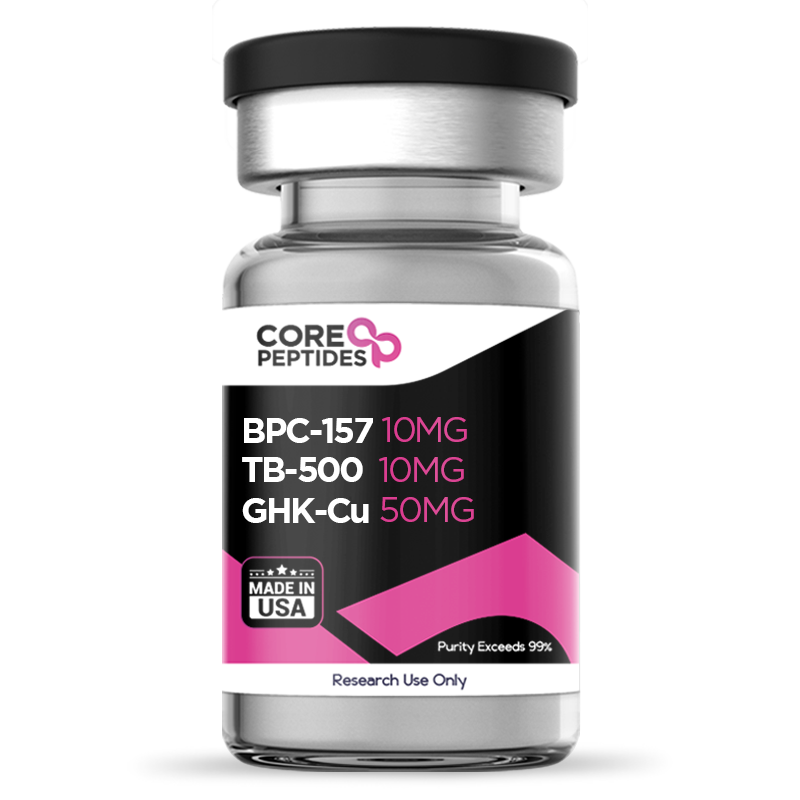
BPC-157 & TB-500 & GHK-Cu Blend (70mg)
$300.00
Size: 70mg
Contents: BPC-157 (10mg) & TB-500 (10mg) & GHK-Cu (50mg)
Form: Lyophilized powder
Purity: >99%
SKU: BPC-157-TB-500-GHK-Cu-70mg
FREE Shipping on $200+ orders
Discount per Quantity
| Quantity | 5 - 8 | 9 + |
|---|---|---|
| Discount | 5% | 10% |
| Price | $285.00 | $270.00 |
BPC-157 & TB-500 & GHK-Cu Blend
BPC-157 appears to be a distinct synthetic peptide composed of fifteen amino acids and is thought to originate from a fragment of a gastric protein. However, the specific protein has not yet been established. Research models indicate that BPC-157 may interact with intracellular signaling systems relevant to vascular growth via angiogenic signaling and inflammatory regulation via attenuation of pro-inflammatory pathways. (1)
TB-500 is a synthetic peptide identical to the 43 amino acid structure of the endogenous thymosin beta-4, studied for its involvement in cellular migration, cytoskeletal organization, and inflammatory signaling. In vitro studies suggest that exposure to TB-500 may support cell movement and structural coordination, and may also participate in signaling pathways linked to angiogenesis and modulation of inflammatory mediators. (2)
GHK-Cu is a peptide complex consisting of the tripeptide GHK (glycine, histidine, and lysine), bound to a divalent copper ion (Cu²⁺). Researchers suggest that the GHK sequence may occur endogenously, specifically being released by cells, including fibroblasts, macrophages, and lymphocytes, during damage, as a result of collagen breakdown. (3) Thus, GHK-Cu is posited to act as a repair signal, capable of interacting with enzymes, ion channels, and cell-surface receptors, with reported downstream potential on gene expression. The presence of copper may be central to these observations, including collagen synthesis, modulation of inflammatory signaling, and antioxidant potential.
These peptides may have partially overlapping but also complementary actions, supporting the hypothesis that combined exposure may positively affect inflammatory signaling. In addition, the peptides may all play some role in the regeneration of different cells, possibly supporting factors like vascular formation and cellular behavior.
Chemical Makeup
Other Known Titles
- BPC-157: C62H98N16O22
- TB-500: C212H350N56O78S
- GHK-Cu: C14H23CuN6O4
Molecular Weight:
- BPC-157:5 g/mol
- TB-500: 4963 g/mol
- GHK-Cu: 38 g/mol
Molecular Formula:
- BPC-157: Body Protection Compound-157
- TB-500: Synthetic Thymosin Beta-4
- GHK-Cu: glycyl-L-histidyl-L-lysine-copper 2+
Research and Clinical Studies
Anti-inflammatory Signaling Research on BPC-157 & TB-500 & GHK-Cu
All three peptides appear to play some potentially complementary and partially overlapping roles in inflammatory signaling inside and in between cells. Notably, all three appear to have a positive action on toning down inflammatory processes. For example, research conducted in laboratory settings by Santra et al. suggests that TB-500 may lower inflammation-related signaling inside cell cultures of developing brain support cells called oligodendrocyte progenitor cells. (4) After cell stress or injury, these cells are posited to activate innate immune pathways, especially Toll-like receptor (TLR) signaling, which may drive inflammatory responses inside the cell.
The authors research whether TB-500 may tone down this signaling and suggest that the peptide may increase the level of miR-146a, a small regulatory RNA molecule whose role may be to act as an internal brake on inflammatory signaling pathways. When miR-146a levels rise, two key TLR signaling proteins, IRAK1 and TRAF6, may decrease, and thus they may not transmit inflammatory signals inside the cell, including pathways linked to NF-κB activation, which would otherwise play a major role in inflammatory signaling.
Furthermore, research by Sikiric et al. suggests that BPC-157 may also interact with inflammatory signaling, specifically by attenuating inflammatory cell infiltration in research models. (5) Apparently, the researchers observed lower levels of biochemical markers linked to inflammation, including markers of neutrophil accumulation, leukotriene B4, and thromboxane B2 in inflamed cellular cultures.
This peptide also appeared to modulate immune cell behavior, with reports of increased macrophage activity, which may support resolution rather than persistence of inflammation. Importantly, these implications were observed without direct immunosuppression of specific cytokines such as TNF, implying a more regulatory mode of action. BPC-157 may “interact with the NO-system [nitric oxide system], providing endothelium protection”, which may indirectly limit inflammatory amplification by preserving microvascular integrity.
Last but not least, experiments by Park et al. suggest that GHK-Cu may also tone down inflammatory signaling in macrophages activated by pro-inflammatory triggers and in lung cell injury models. (6) In activated macrophages, GHK-Cu apparently lowered intracellular reactive oxygen species and restored superoxide dismutase activity toward control values. The pro-inflammatory triggers apparently increased TNF-α and IL-6 release, while GHK-Cu apparently reduced both cytokines.
Mechanistically, the authors suggest that GHK-Cu may have suppressed NF-κB activation by reducing the activation of key regulators. The researchers did not notice significant action on ERK1/2, JNK1/2, or NO secretion. In the lung cell cultures, the peptide complex apparently reduced edema, inflammatory cell infiltration, and overall histologic injury scores. The researchers also observed reductions in TNF-α, IL-6, total cell counts, neutrophils, MPO activity, and markers of alveolar permeability.
Cellular Regeneration Potential of BPC-157 & TB-500 & GHK-Cu
In addition to their potentially positive actions on toning down inflammatory signaling, all three peptides have been posited to also support cellular regeneration via different mechanisms that ultimately support vascularity and nutrient delivery to the cellular structure. Notably, TB-500 has been posited to exert positive actions on cellular regeneration by interacting with cellular mobility and thus supporting angiogenesis.
Research by Lv et al. suggests that TB-500 may interact with cell movement as it binds globular actin (G-actin) and may modulate how actin filaments assemble to plausibly make endothelial cells more able to change shape, migrate, and form multicellular structures. (7) That type of motility is a basic requirement for sprouting angiogenesis, where endothelial cells need to move into hypoxic tissue and organize into new tubes.
The researchers suggest that during evaluation, the peptide increased cell viability and migration and increased tube formation on matrices, which is commonly exposed to research models as a lab proxy for angiogenic behavior. In parallel, TB-500 appeared to increase expression of angiogenesis-linked factors, including VEGFA, angiopoietin-2 (Ang2), and the Tie2 receptor. Mechanistically, the study posits that TB-500 may push angiogenesis through a Notch to NF-κB signaling axis. Thus, TB-500 may be hypothesized to support angiogenesis by combining a cytoskeleton-linked increase in endothelial motility with signaling changes that raise pro-angiogenic programs (VEGF-A and Ang2/Tie2) via Notch/NF-κB coupling in damaged cellular structure.
Research by Sikiric et al. also suggests that BPC-157 may also support angiogenesis and thus cellular regeneration. (8) More specifically, this peptide may act indirectly by stabilizing the vascular environment needed for new vessel growth. Across multiple injury models, the researchers have observed that the peptide may work by protecting endothelial cells and preserving vessel patency. Such endothelium protection creates conditions in which endothelial sprouting and maturation may occur.
At the cellular level, BPC-157 has been linked to activation of repair-associated signaling pathways, including Egr-1 with its regulator NAB2, and FAK–paxillin signaling, which are potentially involved in cell adhesion and migration. These processes are essential for endothelial movement through the extracellular matrix during capillary sprouting. The peptide has also been associated with normalised NO signaling under both excessive and suppressed NO states, counteracting the implications of NOS blockade and NO overproduction. Because NO regulates vasodilation, endothelial survival, and angiogenic signaling, this balancing may support perfusion of injured cellular structures and facilitate endothelial activation and vessel remodeling during repair.
Mechanistically, research on GHK-Cu by Mulder et al. also suggests that the peptide may upregulate VEGF, increase endothelial cell proliferation, and promote endothelial migration and tube formation. (9) These actions are consistent with stimulation of angiogenesis. At the same time, copper itself is a required cofactor for several angiogenic enzymes and transcriptional programs, and the GHK peptide appears to deliver copper in a biologically functional form at sites of cellular injury.
Collagen Repair Potential of BPC-157 & TB-500 & GHK-Cu
Multiple experiments with each of the three peptides also suggest that they may support the regeneration and repair of collagen and other supporting structures in cell cultures such as tendon fibroblasts. For example, research on TB-500 by Xu et al. may support the structural organization in models of recovering tendon fibroblasts. (10) Apparently, the researchers observed collagen fibers that were more uniformly aligned along the ligament axis and more evenly spaced than in controls. Electron microscopy suggested larger collagen fibril diameters, a feature linked to better-supported mechanical properties. These structural changes apparently were accompanied by higher tensile strength and stiffness of the recovered tendon structures.
Based on this data, the researchers posit that TB-500 may support how ligament fibroblasts organize and deposit collagen during repair, improving tissue quality. BPC-157 may also support repair by supporting tendon fibroblasts, as the research by Chang reports accelerated fibroblast migration and spreading in laboratory studies, both of which are essential for repopulating an injury site. Apparently, the peptide may also have better supported fibroblast survival under oxidative stress, a condition commonly present in injured tendon cell cultures.
At the cellular level, these implications were posited to be related to the upregulation of actin fiber formation, as the researchers commented that “F-actin formation as detected by FITC-phalloidin staining was induced in BPC 157” exposed cells. Moreover, the activation of focal adhesion signaling through phosphorylation of FAK and paxillin is also posited to aid cell attachment and movement within the extracellular matrix, thus ultimately facilitating repair.
GHK-Cu may also promote collagen synthesis, particularly in the binding between tendon cells and bone cells. Research by Fu et al. suggests that research models exposed to the peptide complex may have better bone formation around tendon cell grafts and a trend toward higher cell presence within the graft structure itself. Overall, all three peptides appear to exert potential positive actions linked to cellular repair and integrity, including anti-inflammatory signaling, angiogenesis, collagen synthesis, and more. Unfortunately, research investigating the simultaneous experimentation with all three compounds has yet to be conducted.
BPC-157 & TB-500 & GHK-Cu blend is available for research and laboratory purposes only. Please review our Terms and Conditions before ordering.
References:
- Seiwerth S, Milavic M, Vukojevic J, Gojkovic S, Krezic I, Vuletic LB, Pavlov KH, Petrovic A, Sikiric S, Vranes H, Prtoric A, Zizek H, Durasin T, Dobric I, Staresinic M, Strbe S, Knezevic M, Sola M, Kokot A, Sever M, Lovric E, Skrtic A, Blagaic AB, Sikiric P. Stable Gastric Pentadecapeptide BPC 157 and Wound Healing. Front Pharmacol. 2021 Jun 29;12:627533. doi: 10.3389/fphar.2021.627533. PMID: 34267654; PMCID: PMC8275860.
- Maar, K., Hetenyi, R., Maar, S., Faskerti, G., Hanna, D., Lippai, B., Takatsy, A., & Bock-Marquette, I. (2021). Utilizing Developmentally Essential Secreted Peptides Such as Thymosin Beta-4 to Remind the Adult Organs of Their Embryonic State-New Directions in Anti-Aging Regenerative Therapies. Cells, 10(6), 1343. https://doi.org/10.3390/cells10061343
- Maquart FX, Pickart L, Laurent M, Gillery P, Monboisse JC, Borel JP. Stimulation of collagen synthesis in fibroblast cultures by the tripeptide-copper complex glycyl-L-histidyl-L-lysine-Cu2+. FEBS Lett. 1988 Oct 10;238(2):343-6. doi: 10.1016/0014-5793(88)80509-x. PMID: 3169264.
- Santra M, Zhang ZG, Yang J, Santra S, Santra S, Chopp M, Morris DC. Thymosin β4 up-regulation of microRNA-146a promotes oligodendrocyte differentiation and suppression of the Toll-like proinflammatory pathway. J Biol Chem. 2014 Jul 11;289(28):19508-18. doi: 10.1074/jbc.M113.529966. Epub 2014 May 14. PMID: 24828499; PMCID: PMC4094061.
- Sikiric P, Seiwerth S, Rucman R, Turkovic B, Rokotov DS, Brcic L, Sever M, Klicek R, Radic B, Drmic D, Ilic S, Kolenc D, Stambolija V, Zoricic Z, Vrcic H, Sebecic B. Focus on ulcerative colitis: stable gastric pentadecapeptide BPC 157. Curr Med Chem. 2012;19(1):126-32. doi: 10.2174/092986712803414015. PMID: 22300085.
- Park JR, Lee H, Kim SI, Yang SR. The tripeptide GHK-Cu complex ameliorates lipopolysaccharide-induced acute lung injury in mice. Oncotarget. 2016 Sep 6;7(36):58405-58417. doi: 10.18632/oncotarget.11168. PMID: 27517151; PMCID: PMC5295439.
- Lv S, Cai H, Xu Y, Dai J, Rong X, Zheng L. Thymosin‑β 4 induces angiogenesis in critical limb ischemia mice via regulating Notch/NF‑κB pathway. Int J Mol Med. 2020 Oct;46(4):1347-1358. doi: 10.3892/ijmm.2020.4701. Epub 2020 Aug 11. PMID: 32945357; PMCID: PMC7447324.
- Sikiric P, Seiwerth S, Rucman R, Kolenc D, Vuletic LB, Drmic D, Grgic T, Strbe S, Zukanovic G, Crvenkovic D, Madzarac G, Rukavina I, Sucic M, Baric M, Starcevic N, Krstonijevic Z, Bencic ML, Filipcic I, Rokotov DS, Vlainic J. Brain-gut Axis and Pentadecapeptide BPC 157: Theoretical and Practical Implications. Curr Neuropharmacol. 2016;14(8):857-865. doi: 10.2174/1570159x13666160502153022. PMID: 27138887; PMCID: PMC5333585.
- Mulder GD, Patt LM, Sanders L, Rosenstock J, Altman MI, Hanley ME, Duncan GW. Enhanced healing of ulcers in patients with diabetes by topical treatment with glycyl-l-histidyl-l-lysine copper. Wound Repair Regen. 1994 Oct;2(4):259-69. doi: 10.1046/j.1524-475X.1994.20406.x. PMID: 17147644.
- Xu B, Yang M, Li Z, Zhang Y, Jiang Z, Guan S, Jiang D. Thymosin β4 enhances the healing of medial collateral ligament injury in rats. Regul Pept. 2013 Jun 10;184:1-5. doi: 10.1016/j.regpep.2013.03.026. Epub 2013 Mar 21. PMID: 23523891.
- Chang CH, Tsai WC, Lin MS, Hsu YH, Pang JH. The promoting effect of pentadecapeptide BPC 157 on tendon healing involves tendon outgrowth, cell survival, and cell migration. J Appl Physiol (1985). 2011 Mar;110(3):774-80. doi: 10.1152/japplphysiol.00945.2010. Epub 2010 Oct 28. PMID: 21030672.
- Fu SC, Cheuk YC, Chiu WY, Yung SH, Rolf CG, Chan KM. Tripeptide-copper complex GHK-Cu (II) transiently improved healing outcome in a rat model of ACL reconstruction. J Orthop Res. 2015 Jul;33(7):1024-33. doi: 10.1002/jor.22831. Epub 2015 Apr 10. PMID: 25731775.