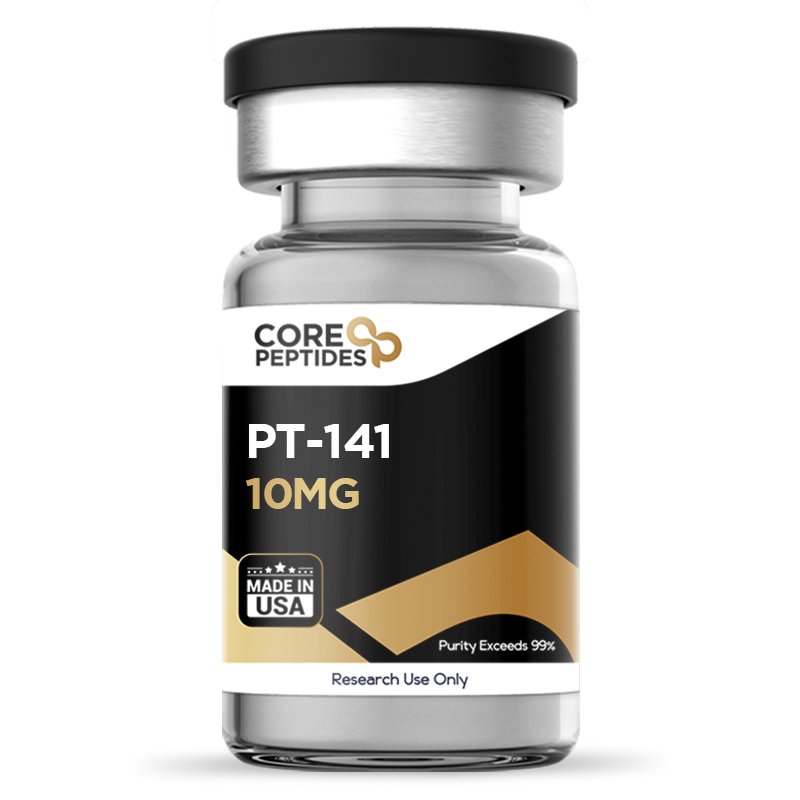
PT-141 (Bremelanotide) – 10MG
$43.00
PT-141 (bremelanotide) is a cyclic seven-amino-acid melanocortin peptide. Content size is 10mg, in the form of lyophilized powder. Peptides are sold for laboratory research use only.
Purity: 99%+ by HPLC (third-party tested)
Tested by: Vanguard Laboratory, see Certificate of Analysis
SKU: P-PT141-10
Discount per Quantity
| Quantity | Discount | Price |
|---|
| 5 - 8 | 5% | $40.85 | |
| 9 + | 10% | $38.70 |
What Is PT-141 (Bremelanotide)?
Bremelanotide, which is also commonly known by PT-141, is a cyclic synthetic peptide composed of seven amino acids.(1) PT-141 synthetic peptide appears to be agonistic to melanocortin receptors, which is similar to the natural hormone alpha-MSH.(2) It is a by-product of the metabolism of another synthetic analog called Melanotan II. Initial studies suggested that melanocortin hormones may regulate various physiological functions. When test animals were presented with the isolated hormone, it was reported to present elevated reproductive functions, which is one of the primary areas of research currently being conducted on PT-141 peptide.
How Is PT-141 Thought to Work?
Studies have suggested that PT-141 shows agonistic properties towards melanocortin receptors, namely MC3R and MC4R, which may result in elevated reactions in the central nervous system. MC3R, which appears to be primarily expressed in the brain, especially within the hypothalamus, might play a role in energy homeostasis. It has been hypothesized by research teams examining melanocortin receptor activity, that MC3R may potentially modulate the actions of other melanocortin receptors in this area. Moreover, MC3R might influence feeding behavior, possibly impacting appetite and food intake, and is thought to be involved in various metabolic processes, including the potential regulation of glucose and lipid metabolism.(3) On the other hand, MC4R is believed to be essential in appetite control. When activated in the brain, it is considered to contribute to appetite regulation. MC4R is also posited to have a role in energy expenditure, with its activation possibly leading to an increase in energy output, which could contribute to weight reduction. This receptor has also been tentatively linked to reproductive function, especially in the potential regulation of the function of penile tissues and overall reproductive behavior.(4) In publicly available study, it was suggested by researchers that following binding with MC3R and MC4R receptors, the peptide appeared to lead to the activation of the neurons found in the hypothalamus, leading to apparently increased immunoreactivity.(2) Neurons in the surrounding region of the central nervous system may also be stimulated as they intake the chemicals which then reportedly lead to sexual arousal in murine models.
PT-141 Specifications
| Name | PT-141 (Bremelanotide) |
| Other known names | Bremelanotide, PT 141 |
| Sequence | Ac-Nle-cyclo[Asp-His-D-Phe-Arg-Trp-Lys]-OH (7 amino acids, cyclic) |
| Molecular formula | C50H68N14O10 |
| Molecular weight | 1025.18 g/mol |
| CAS number | 189691-06-3 |
| Synthesis | Solid-phase peptide synthesis, US |
| Form | Lyophilized powder |
| Amount per vial | 10 mg |
| Purity | >99% (HPLC) |
| Storage | −20 °C, dry, protected from light |
| SKU | P-PT141-10 |
What Does Research Show About PT-141?
What Did Initial Studies of PT-141 Suggest?
Key finding: In female rats, PT-141 selectively increased solicitational behaviors without affecting lordosis, pacing or other sexual behaviors, and without causing generalized motor activation.(5)
This early 2000 study was conducted to understand the potential of PT-141 peptide in murine models. The murine models were used as the subject in this study to determine how the peptide may impact their sexual behavior.(5) After presentation, it was reported that the female rats appeared to exhibit elevated sexual desire without any increase/decrease in the sexual pace, lumbar lordosis, or any other sexually-related behaviors. After analysis, it was suggested by the researchers that the peptide did not directly impact a generalized motor activation, instead it may have potential selective pharmacological impact that may stimulate the central nervous system, mainly the melanocortin receptor activities, which might result in elevated sexual arousal. More specifically, the researchers commented that “The ability of PT-141 to enhance solicitation in two distinctive testing environments indicates that the effect is selective and stable, and suggests that central melanocortin systems are part of the neurochemical network that evokes appetitive sexual behavior in female rats.”(5)
How May PT-141 Affect Arousal in Research Models?
Key finding: In anesthetized rabbits, the related melanocortin agonist Melanotan II (MT-II) increased cavernosal pressure through central melanocortin receptors and neuronal release of nitric oxide; the MC3R/MC4R antagonist SHU 9119 abolished the effect.(6)
The potential activation of the MC4R by PT-141 may also upregulate the production of vasodilators like nitric oxide (NO) in penile tissues, leading to improved erection potential, as suggested by research.(6) The peptide is posited to be a metabolite of Melanotan-2 (MT-II), and both appear to activate the same receptors. For example, it has been posited that melanocortin agonists might lead to concentration-related increases in cavernosal pressure. SHU 9119, an agent that is possibly a non-selective antagonist of MC3R and MC4R, appears not to have had a significant impact on cavernosal or systemic blood pressure. However, it seems to have negated the increases in cavernosal pressure that melanocortin agonists potentially induced. This same agent, SHU 9119, also appears to have inhibited the depressor response that was probably produced by melanocortin agonists. Moreover, when a combination containing phentolamine mesylate, papaverine, and PGE1 was introduced directly into the cavernosal tissue, it reportedly led to a 4-fold increase in cavernosal pressure. The study also hypothesized the role of the NO-cyclic GMP-dependent pathway in relation to the melanocortin agonists-induced increases in cavernosal pressure. This was done by performing a bilateral transection of the pudendal nerves and inhibiting NO synthase using L-NAME. The results indicate that either removing the pudendal nerves or pretreating with L-NAME may negate the increases in intracavernosal pressure that melanocortin agonists likely induced in the anesthetized rabbit models. From the gathered data, it was tentatively inferred that the activation of central melanocortin receptors by melanocortin agonists might lead to an increase in cavernosal pressure, probably achieved through the neuronal release of NO.(6)
How May PT-141 Act on the Central Nervous System?
Key finding: In hormone-primed female rats, PT-141 (Bremelanotide) increased solicitation without altering pacing or lordosis after peripheral exposure or infusion into the lateral ventricles or medial preoptic area, but not the ventromedial hypothalamus.(7)
Studies on PT-141 have aimed to understand the potential of the peptide in the central nervous system (CNS) and possibly also some brain regions.(7) One study was carried out in murine models with rich levels of the female reproductive hormones. Researchers mainly focused on both the sexual behaviors of the rats i.e., appetitive behaviors such as increased pace and agitation, and consummatory behaviors such as lordosis. In this study, the rats were presented with the peptide, which apparently resulted in increased appetitive behavior of solicitation without impacting the sexual pace or lordosis. The actions of PT-141 were noted following both peripheral introductions and introduction directly into the lateral ventricles or medial preoptic area (mPOA), but possibly not the ventromedial hypothalamus. The mPOA may be a significant region for displaying appetitive sexual behaviors in models across various species, though this theory is still being explored. When PT-141 was introduced peripherally, it appeared to activate the mPOA and other hypothalamic and limbic brain regions possibly associated with sexual behavior. The study hypothesizes that PT-141 might function by potentially activating dopamine terminals located in the mPOA, but further research is needed to confirm this. The researchers commented that the peptide “appears to possess the behavioral, pharmacological, and neuroanatomical specificity required” to potentially influence sexual function.(7)
To gain a deeper understanding of these mechanisms, a study was conducted using psychometric, functional neuroimaging, and hormonal analyses. This study was a randomized, double-blinded, placebo-controlled, crossover clinical investigation that aimed to evaluate the impact of MC4R agonism on sexual brain processing. The results indicated that MC4R agonists like PT-141 might elevate sexual desire for up to 24 hours compared to a placebo. Furthermore, during the functional neuroimaging phase, it appeared that MC4R agonism possibly amplified activity in the cerebellar and supplementary motor areas while possibly deactivating the secondary somatosensory cortex, specifically when the subjects were exposed to erotic stimuli, in contrast to the placebo. Moreover, MC4R agonists were hypothesized to boost the functional connectivity between the amygdala and the insula when exposed to erotic stimuli, again compared to the placebo. Based on these observations, researchers posited that MC4R agonists might augment sexual brain processing. This research offers further insights into the mechanisms through which MC4R agonists like PT-141 might influence sexual behavior, shedding light on the ongoing exploration of this class of peptides.(8)
PT-141 Certificate of Analysis
| Batch / lot | C74167 |
| Test date | 7/22/2026 |
| Testing laboratory | Vanguard Laboratory |
| Method | HPLC-UV/VIS (identity and purity) |
| Purity result | 99.26% |
| Full report | Download the PT-141 COA (PDF) |
PT-141 peptide is available for research and laboratory purposes only. We offer free shipping in the US for orders over $200. Please review our Terms and Conditions before ordering.
PT-141 Frequently Asked Questions
What is PT-141?
PT-141, also known as Bremelanotide, is a cyclic synthetic peptide of seven amino acids and an analog of alpha-melanocyte-stimulating hormone (alpha-MSH). Researchers study it as an agonist of melanocortin receptors, mainly MC3R and MC4R.
How is PT-141 related to Melanotan II?
PT-141 is described as a metabolite of Melanotan II. Both are synthetic melanocortin agonists and appear to activate the same receptors.
What is the molecular weight of PT-141?
PT-141 has the molecular formula C50H68N14O10 and a molecular weight of approximately 1025.2 g/mol.
How should PT-141 be stored?
Lyophilized PT-141 should be stored at −20 °C, dry and protected from light.
Is PT-141 third-party tested?
Yes. The current batch (C74167) was tested by a third-party laboratory and showed >99% purity by HPLC. Its certificate of analysis is available on this page.
References:
- National Center for Biotechnology Information (2023). PubChem Compound Summary for CID 9941379, Bremelanotide. PubChem. https://pubchem.ncbi.nlm.nih.gov/compound/Bremelanotide
- Molinoff, P. B., Shadiack, A. M., Earle, D., Diamond, L. E., & Quon, C. Y. (2003). PT-141: a melanocortin agonist for the treatment of sexual dysfunction. Annals of the New York Academy of Sciences, 994, 96–102. https://doi.org/10.1111/j.1749-6632.2003.tb03167.x
- Renquist, B. J., Lippert, R. N., Sebag, J. A., Ellacott, K. L., & Cone, R. D. (2011). Physiological roles of the melanocortin MC₃ receptor. European journal of pharmacology, 660(1), 13–20. https://doi.org/10.1016/j.ejphar.2010.12.025
- Adan, R. A., Tiesjema, B., Hillebrand, J. J., la Fleur, S. E., Kas, M. J., & de Krom, M. (2006). The MC4 receptor and control of appetite. British journal of pharmacology, 149(7), 815–827. https://doi.org/10.1038/sj.bjp.0706929
- Pfaus, J. G., Shadiack, A., Van Soest, T., Tse, M., & Molinoff, P. (2004). Selective facilitation of sexual solicitation in the female rat by a melanocortin receptor agonist. Proceedings of the National Academy of Sciences of the United States of America, 101(27), 10201–10204. https://doi.org/10.1073/pnas.0400491101
- Vemulapalli, R., Kurowski, S., Salisbury, B., Parker, E., & Davis, H. (2001). Activation of central melanocortin receptors by MT-II increases cavernosal pressure in rabbits by the neuronal release of NO. British journal of pharmacology, 134(8), 1705–1710. https://doi.org/10.1038/sj.bjp.0704437
- Pfaus, J., Giuliano, F., & Gelez, H. (2007). Bremelanotide: an overview of preclinical CNS effects on female sexual function. The journal of sexual medicine, 4(Suppl 4), 269–279. https://doi.org/10.1111/j.1743-6109.2007.00610.x
- Thurston, L., Hunjan, T., Mills, E. G., Wall, M. B., Ertl, N., Phylactou, M., Muzi, B., Patel, B., Alexander, E. C., Suladze, S., Modi, M., Eng, P. C., Bassett, P. A., Abbara, A., Goldmeier, D., Comninos, A. N., & Dhillo, W. S. (2022). Melanocortin 4 receptor agonism enhances sexual brain processing in women with hypoactive sexual desire disorder. The Journal of clinical investigation, 132(19), e152341. https://doi.org/10.1172/JCI152341
Related reading: PT-141 research overview and Melanotan II and melanocortin receptors.