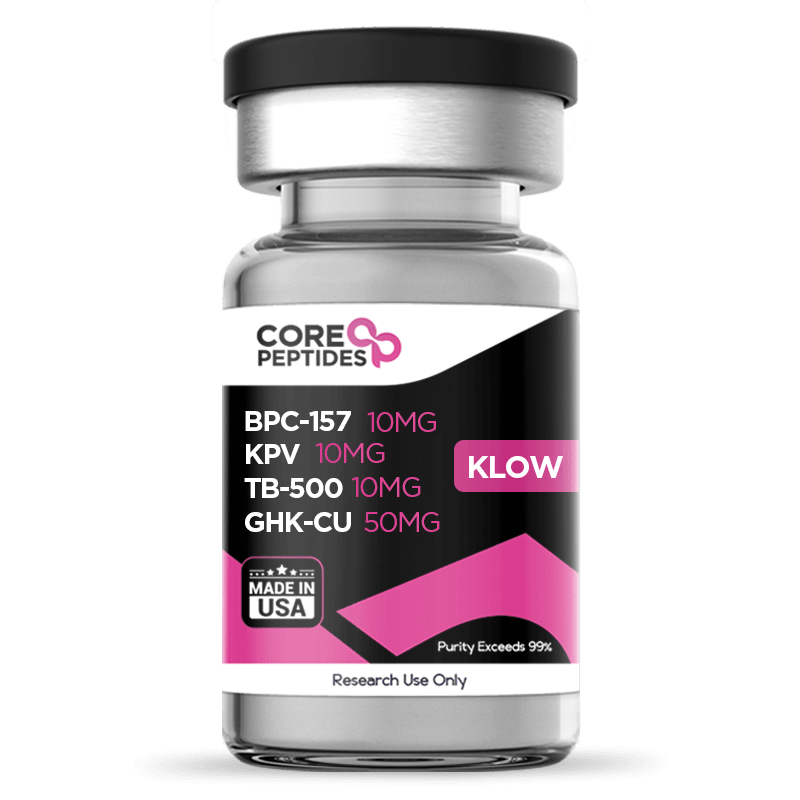
KLOW (BPC-157, KPV, TB-500, GHK-Cu) Blend – 80MG
$160.00
KLOW is a blend of BPC-157, KPV, TB-500 and GHK-Cu. Content total size is 80mg (10mg/10mg/10mg/50mg), in the form of lyophilized powder. Peptides are sold for laboratory research use only.
Purity: 99%+ by HPLC (third-party tested)
Tested by: Vanguard Laboratory, see Certificate of Analysis
SKU: klow-80mg
Discount per Quantity
| Quantity | Discount | Price |
|---|
| 5 - 8 | 5% | $152.00 | |
| 9 + | 10% | $144.00 |
What Is the KLOW Blend?
BPC-157 (10mg), KPV (10mg), TB-500 (10mg), and GHK-Cu (50mg)
BPC-157, TB-500, GHK-Cu, and KPV (KLOW blend) are peptides under investigation in laboratory models for their potential to support inflammatory signaling, angiogenesis, and repair mechanisms. Structurally, they differ considerably. BPC-157 appears to be a synthetic pentadecapeptide, TB-500 mirrors the endogenous thymosin beta-4, GHK-Cu is a tripeptide with a copper ion, and KPV represents the C-terminal segment of alpha-melanocyte-stimulating hormone.
Each peptide appears to converge on overlapping repair-associated processes, which supports the hypothesis that their combined exposure is the KLOW Blend. Together, these four peptides form what is referred to as the KLOW Blend, because their actions are hypothesized to be partly overlapping and partly complementary based on the available research data.
KLOW Blend Specifications
| Name | KLOW Blend (BPC-157, KPV, TB-500, GHK-Cu) |
| Amount per vial | 80 mg: BPC-157 10 mg, KPV 10 mg, TB-500 10 mg, GHK-Cu 50 mg |
| Other known names | BPC-157: Body Protection Compound-157; KPV: MSH(11-13), ACTH(11-13), alpha-MSH(11-13); TB-500: Synthetic Thymosin Beta-4; GHK-Cu: glycyl-L-histidyl-L-lysine-copper 2+ |
| Molecular formula | BPC-157: C62H98N16O22; KPV: C16H30N4O4; TB-500: C212H350N56O78S; GHK-Cu: C14H23CuN6O4 |
| Molecular weight | BPC-157: 1419.5 g/mol; KPV: 342.4 g/mol; TB-500: 4963 g/mol; GHK-Cu: 402.9 g/mol |
| Synthesis | Solid-phase peptide synthesis, US |
| Form | Lyophilized powder |
| Purity | >99% (HPLC) |
| Storage | −20 °C, dry, protected from light |
| SKU | klow-80mg |
What Does Research Show About the KLOW Blend?
What Are the Potential Properties of the KLOW Blend Peptides?
Key finding: In fibroblast cultures, the copper complex GHK-Cu stimulated collagen synthesis.(3)
BPC-157 appears to be a synthetic peptide built from fifteen amino acids, with a potential parent protein remaining undefined. Laboratory models by the team of Sikiric et al. point toward a possible interaction between BPC-157 and intracellular signaling systems tied to vascular growth through angiogenic pathways and to inflammatory control through the dampening of pro-inflammatory cascades.(1)
TB-500 appears to be another synthetic peptide with a sequence that mimics the endogenously occurring thymosin beta-4. The molecule has drawn attention for its apparent involvement in cell migration, cytoskeletal arrangement, and inflammatory signaling. Data from cell culture experiments such as those by Maar et al. hint that TB-500 exposure may assist cellular movement and structural organization while also potentially engaging pathways connected to angiogenesis and the regulation of inflammatory mediators.(2)
GHK-Cu is a peptide complex made from the tripeptide GHK, composed of glycine, histidine, and lysine, joined to a divalent copper ion (Cu²⁺). Investigators such as Maquart et al. propose that the GHK sequence may arise endogenously as a signal that there is a process causing collagen breakdown, and repair is needed.(3)GHK-Cu is posited to function as a repair-associated signal that may engage fibroblasts, immune cells, enzymes, ion channels, and cell-surface receptors, with reported downstream potential over gene expression. Copper itself may be central to these potential actions, which may include collagen formation, adjustment of inflammatory signaling, and possible antioxidant activity.
KPV is a tripeptide made of lysine, proline, and valine, corresponding to the C-terminal segment of alpha-melanocyte-stimulating hormone (α-MSH). Research models by Böhm et al. suggest that KPV may carry much of the anti-inflammatory potential attributed to the larger α-MSH molecule while remaining a comparatively minimal fragment.(4) Potential mechanisms may involve reduction of NF-κB and MAP kinase signaling, and interactions with vasodilators like nitric oxide (NO), thereby possibly lowering pro-inflammatory cytokine output.
Do the KLOW Blend Peptides Affect Anti-inflammatory Signaling in Laboratory Studies?
Key finding: In oligodendrocyte progenitor cell cultures, thymosin beta-4 increased microRNA-146a and suppressed the Toll-like receptor inflammatory pathway (IRAK1 and TRAF6).(5)
All four peptides are posited to occupy potentially complementary and partly overlapping positions within inflammatory signaling both inside cells and across the space between them. For example, laboratory work by Santra et al. suggests that TB-500 may reduce inflammation-linked signaling within cultures of developing brain support cells referred to as oligodendrocyte progenitor cells.(5)
When such cells encounter stress or injury, they are posited to switch on innate immune routes, particularly Toll-like receptor (TLR) signaling, which may fuel inflammatory activity inside the cell. The authors examined whether TB-500 may soften this signaling and suggested that the peptide may raise levels of miR-146a. This small regulatory RNA molecule may serve as an internal brake on inflammatory routes.
As miR-146a climbs, two central TLR signaling proteins named IRAK1 and TRAF6 may fall and consequently may fail to relay inflammatory signals through the cell, including routes tied to NF-κB activation that would otherwise weigh heavily on inflammatory output. Research by Sikiric et al. further suggests that BPC-157 may also engage inflammatory signaling by curbing the infiltration of inflammatory cells in laboratory models.(6)
When experimenting with the peptide, the investigators apparently recorded lower readings of biochemical markers associated with inflammation, among them indicators of neutrophil buildup, leukotriene B4, and thromboxane B2 within inflamed cell cultures. This peptide also appeared to adjust immune cell behavior, with reports of heightened macrophage activity that may steer inflammation toward resolution rather than persistence.
These outcomes reportedly emerged without direct suppression of specific cytokines such as TNF, which implies a more regulatory character. BPC-157 may "interact with the NO-system, providing endothelium protection," which may indirectly restrain inflammatory amplification by keeping microvascular structure intact.
Further experiments by Park et al. indicate that GHK-Cu may also temper inflammatory signaling in macrophages roused by pro-inflammatory triggers and in models of cell injury.(7) Within activated macrophages, GHK-Cu apparently lowered intracellular reactive oxygen species and nudged superoxide dismutase activity back toward baseline.
The pro-inflammatory triggers apparently drove up TNF-α and IL-6 release, whereas GHK-Cu apparently pulled both cytokines down. The authors propose that GHK-Cu may have blunted NF-κB activation by reducing the activation of key regulators. KPV may round out the anti-inflammatory profile of the KLOW Blend through a distinct route, as suggested by laboratory work by Dalmasso et al., who posit that KPV may enter epithelial and immune cell cultures through the PepT1 transporter and, once inside, may suppress inflammatory signaling.(8)
Specifically, in cultured epithelial cells stimulated with IL-1β, evaluating the peptide alongside KPV apparently slowed the degradation of IκB-α and shortened the window of NF-κB activation, which may indicate a more restrained inflammatory response. The peptide also apparently reduced IL-1β-driven phosphorylation of ERK1/2, JNK, and p38, pointing toward broad dampening of MAP kinase signaling. In parallel, KPV apparently lowered IL-8 output, and in immune cell cultures stimulated with TNF-α it apparently preserved IκB-α while trimming IL-8 messenger RNA.
Do the KLOW Blend Peptides Support Extracellular Matrix Proteins in Research Models?
Key finding: In murine models of medial collateral ligament injury, thymosin beta-4 was associated with more evenly organized collagen and improved mechanical properties of the healing ligament.(9)
Multiple experiments with each peptide also suggest possible support for the regeneration and repair of extracellular matrix proteins (ECM) such as collagen and other supporting structures within cell cultures. As an example, research on TB-500 by Xu et al. suggests that the peptide may reinforce structural organization in models of recovering tendon fibroblasts.(9) The investigators apparently observed collagen fibers aligned more uniformly along the ligament axis and spaced more evenly in exposed cultures than in control cultures that were not exposed to the peptide.
Electron microscopy results also suggested larger collagen fibril diameters, a feature tied to better-supported mechanical properties. These structural shifts apparently coincided with greater tensile strength and stiffness in the recovered tendon structures. On this basis, the researchers posit that TB-500 may support how ligament fibroblasts organize and lay down collagen during repair and thereby support tissue quality.
BPC-157 may also assist repair by supporting tendon fibroblasts, as research by Chang et al. reports quickened fibroblast migration and spreading in laboratory studies, both of which are essential for repopulating an injury site.(10) The peptide apparently offered better fibroblast survival under oxidative stress, a condition commonly present in injured tendon cell cultures.
At the cellular level, these outcomes were posited to relate to the upregulation of actin fiber formation, which may have a synergistic potential with TB-500. The researchers commented that "F-actin formation as detected by FITC-phalloidin staining was induced in BPC 157-exposed" cells. The activation of focal adhesion signaling through phosphorylation of FAK and paxillin is also posited to assist cell attachment and movement within the extracellular matrix and thereby facilitate repair.
GHK-Cu may additionally promote collagen synthesis, particularly at the interface between tendon cells and bone cells. Research by Fu et al. suggests that laboratory models exposed to the complex may indicate better-supported bone cell growth around tendon cell grafts and a trend toward greater cell presence inside the graft structure.(11)
KPV may also contribute to the collagen and repair dimension of the KLOW Blend by quieting the inflammatory environment that often accompanies tissue damage in culture. Because KPV apparently curbs NF-κB and MAPK signaling and lowers pro-inflammatory cytokine release, it may help create conditions under which fibroblast activity and matrix deposition may continue with less inflammatory interference.(8) Reports on the α-MSH family more broadly also suggest that Lys-Pro-Val may ease fibroblast stress in dermal cell injury models, which points toward a possible supporting role in structural repair.(4)
Do the KLOW Blend Peptides Support Tissue Regeneration in Research Models?
Key finding: In mice with critical limb ischemia, thymosin beta-4 induced angiogenesis through the Notch/NF-κB pathway.(12)
Beyond their apparent calming action on inflammatory signaling, the peptides have been posited to support cellular regeneration through varied mechanisms that ultimately reinforce vascularity and the delivery of nutrients to cellular structures. Notably, TB-500 in particular has been posited to favor cellular regeneration by supporting cell mobility and thereby encouraging angiogenesis. Research by Lv et al. suggests that TB-500 may shape cell movement as it binds globular actin (G-actin) and may adjust how actin filaments assemble to plausibly render cells more capable of changing shape, migrating, and organizing into multicellular structures.(12)
Such motility is a baseline requirement for sprouting angiogenesis, where vascular cells must advance into hypoxic tissue and arrange themselves into fresh tubes. The peptide reportedly raised cell viability and migration and increased tube formation on matrices, a common laboratory proxy for angiogenic behavior.
TB-500 also appeared to lift expression of angiogenesis-linked factors such as VEGFA, angiopoietin-2 (Ang2), and the Tie2 receptor. Mechanistically, the study by Lv et al. posits that TB-500 may drive angiogenesis through a Notch to NF-κB signaling axis. TB-500 may therefore be hypothesized to encourage angiogenesis by pairing a cytoskeleton-linked rise in endothelial motility with signaling shifts that elevate pro-angiogenic programs such as VEGF-A and Ang2/Tie2 through Notch/NF-κB coupling in damaged cellular structures.
Further research by Sikiric et al. also suggests that BPC-157 may aid angiogenesis and, in turn, cellular regeneration.(13) The peptide may act indirectly by steadying the vascular setting required for new vessel growth. Across several injury models, the investigators observed that the peptide may work by shielding endothelial cells and preserving vessel patency. Such endothelium protection may set up conditions in which endothelial sprouting and maturation may proceed.
At the cellular level, BPC-157 has been linked to the activation of repair-associated signaling routes, including Egr-1 with its regulator NAB2 and FAK–paxillin signaling, which may participate in cell adhesion and migration. The peptide has additionally been associated with normalized NO signaling under both excessive and suppressed NO states, offsetting the consequences of NOS blockade and NO overproduction.
Because NO is posited to govern vasodilation, endothelial survival, and angiogenic signaling, this balancing may support perfusion of injured cellular structures and facilitate endothelial activation and vessel remodeling. Additional investigations by Bonfiglio et al. have evaluated whether the KPV peptide may also support the repair of tissue models, specifically examining the potential mediating role of NO, similarly to BPC-157. (14)
Specifically, the researchers experimented with laboratory models featuring mechanically induced abrasions and suggest that the peptide may quicken the recovery of the tissues. Specifically, they commented that all models exposed to KPV achieved complete structural regeneration within 60 hours, whereas control models failed to reach full closure in the same period. This reparative action was apparently blocked when a mitigator of nitric oxide synthase was also added to the experiment.
KLOW Blend Certificate of Analysis
| Batch / lot | C74208 |
| Test date | 8/5/2026 |
| Testing laboratory | Vanguard Laboratory |
| Method | HPLC-UV/VIS (purity) |
| Purity result | 99.64% |
| Full report | Download the KLOW Blend COA (PDF) |
KLOW peptide blend is available for research and laboratory purposes only. We offer free shipping in the US for orders over $200. Please review our Terms and Conditions before ordering.
KLOW Blend Frequently Asked Questions
What’s in the KLOW Blend?
Each 80mg vial contains BPC-157 (10mg), KPV (10mg), TB-500 (10mg) and GHK-Cu (50mg), in the form of lyophilized powder.
What are the molecular weights of the KLOW Blend peptides?
BPC-157 is approximately 1419.5 g/mol, KPV 342.4 g/mol, TB-500 4963 g/mol and GHK-Cu 402.9 g/mol.
Has the KLOW Blend been studied as a combination?
The research summarized on this page examined BPC-157, TB-500, GHK-Cu and KPV individually, not the four-peptide combination.
How should the KLOW Blend be stored?
The lyophilized blend should be stored at −20 °C, dry and protected from light.
Is the KLOW Blend third-party tested?
Yes. The current batch (C74208) was tested by a third-party laboratory and showed >99% purity by HPLC. Its certificate of analysis is available on this page.
References:
- Seiwerth, S., Milavic, M., Vukojevic, J., Gojkovic, S., Krezic, I., Vuletic, L. B., Pavlov, K. H., Petrovic, A., Sikiric, S., Vranes, H., Prtoric, A., Zizek, H., Durasin, T., Dobric, I., Staresinic, M., Strbe, S., Knezevic, M., Sola, M., Kokot, A., … Sikiric, P. (2021). Stable Gastric Pentadecapeptide BPC 157 and Wound Healing. Frontiers in pharmacology, 12, 627533. https://doi.org/10.3389/fphar.2021.627533
- Maar, K., Hetenyi, R., Maar, S., Faskerti, G., Hanna, D., Lippai, B., Takatsy, A., & Bock-Marquette, I. (2021). Utilizing Developmentally Essential Secreted Peptides Such as Thymosin Beta-4 to Remind the Adult Organs of Their Embryonic State-New Directions in Anti-Aging Regenerative Therapies. Cells, 10(6), 1343. https://doi.org/10.3390/cells10061343
- Maquart, F. X., Pickart, L., Laurent, M., Gillery, P., Monboisse, J. C., & Borel, J. P. (1988). Stimulation of collagen synthesis in fibroblast cultures by the tripeptide-copper complex glycyl-L-histidyl-L-lysine-Cu2+. FEBS letters, 238(2), 343–346. https://doi.org/10.1016/0014-5793(88)80509-x
- Böhm, M., Luger, T. A., Tobin, D. J., & García-Borrón, J. C. (2006). Melanocortin receptor ligands: new horizons for skin biology and clinical dermatology. The Journal of investigative dermatology, 126(9), 1966–1975. https://doi.org/10.1038/sj.jid.5700421
- Santra, M., Zhang, Z. G., Yang, J., Santra, S., Santra, S., Chopp, M., & Morris, D. C. (2014). Thymosin β4 up-regulation of microRNA-146a promotes oligodendrocyte differentiation and suppression of the Toll-like proinflammatory pathway. The Journal of biological chemistry, 289(28), 19508–19518. https://doi.org/10.1074/jbc.m113.529966
- Sikiric, P., Seiwerth, S., Rucman, R., Turkovic, B., Rokotov, D. S., Brcic, L., Sever, M., Klicek, R., Radic, B., Drmic, D., Ilic, S., Kolenc, D., Stambolija, V., Zoricic, Z., Vrcic, H., & Sebecic, B. (2012). Focus on ulcerative colitis: stable gastric pentadecapeptide BPC 157. Current medicinal chemistry, 19(1), 126–132. https://doi.org/10.2174/092986712803414015
- Park, J. R., Lee, H., Kim, S. I., & Yang, S. R. (2016). The tri-peptide GHK-Cu complex ameliorates lipopolysaccharide-induced acute lung injury in mice. Oncotarget, 7(36), 58405–58417. https://doi.org/10.18632/oncotarget.11168
- Dalmasso, G., Charrier-Hisamuddin, L., Nguyen, H. T., Yan, Y., Sitaraman, S., & Merlin, D. (2008). PepT1-mediated tripeptide KPV uptake reduces intestinal inflammation. Gastroenterology, 134(1), 166–178. https://doi.org/10.1053/j.gastro.2007.10.026
- Xu, B., Yang, M., Li, Z., Zhang, Y., Jiang, Z., Guan, S., & Jiang, D. (2013). Thymosin β4 enhances the healing of medial collateral ligament injury in rat. Regulatory peptides, 184, 1–5. https://doi.org/10.1016/j.regpep.2013.03.026
- Chang, C. H., Tsai, W. C., Lin, M. S., Hsu, Y. H., & Pang, J. H. (2011). The promoting effect of pentadecapeptide BPC 157 on tendon healing involves tendon outgrowth, cell survival, and cell migration. Journal of applied physiology (Bethesda, Md. : 1985), 110(3), 774–780. https://doi.org/10.1152/japplphysiol.00945.2010
- Fu, S. C., Cheuk, Y. C., Chiu, W. Y., Yung, S. H., Rolf, C. G., & Chan, K. M. (2015). Tripeptide-copper complex GHK-Cu (II) transiently improved healing outcome in a rat model of ACL reconstruction. Journal of orthopaedic research : official publication of the Orthopaedic Research Society, 33(7), 1024–1033. https://doi.org/10.1002/jor.22831
- Lv, S., Cai, H., Xu, Y., Dai, J., Rong, X., & Zheng, L. (2020). Thymosin‑β 4 induces angiogenesis in critical limb ischemia mice via regulating Notch/NF‑κB pathway. International journal of molecular medicine, 46(4), 1347–1358. https://doi.org/10.3892/ijmm.2020.4701
- Sikiric, P., Seiwerth, S., Rucman, R., Kolenc, D., Vuletic, L. B., Drmic, D., Grgic, T., Strbe, S., Zukanovic, G., Crvenkovic, D., Madzarac, G., Rukavina, I., Sucic, M., Baric, M., Starcevic, N., Krstonijevic, Z., Bencic, M. L., Filipcic, I., Rokotov, D. S., & Vlainic, J. (2016). Brain-gut Axis and Pentadecapeptide BPC 157: Theoretical and Practical Implications. Current neuropharmacology, 14(8), 857–865. https://doi.org/10.2174/1570159x13666160502153022
- Bonfiglio, V., Camillieri, G., Avitabile, T., Leggio, G. M., & Drago, F. (2006). Effects of the COOH-terminal tripeptide alpha-MSH(11-13) on corneal epithelial wound healing: role of nitric oxide. Experimental eye research, 83(6), 1366–1372. https://doi.org/10.1016/j.exer.2006.07.014
Related reading: GHK-Cu mechanisms and studies and TB-500 and BPC-157 blend research on tissue regeneration.