


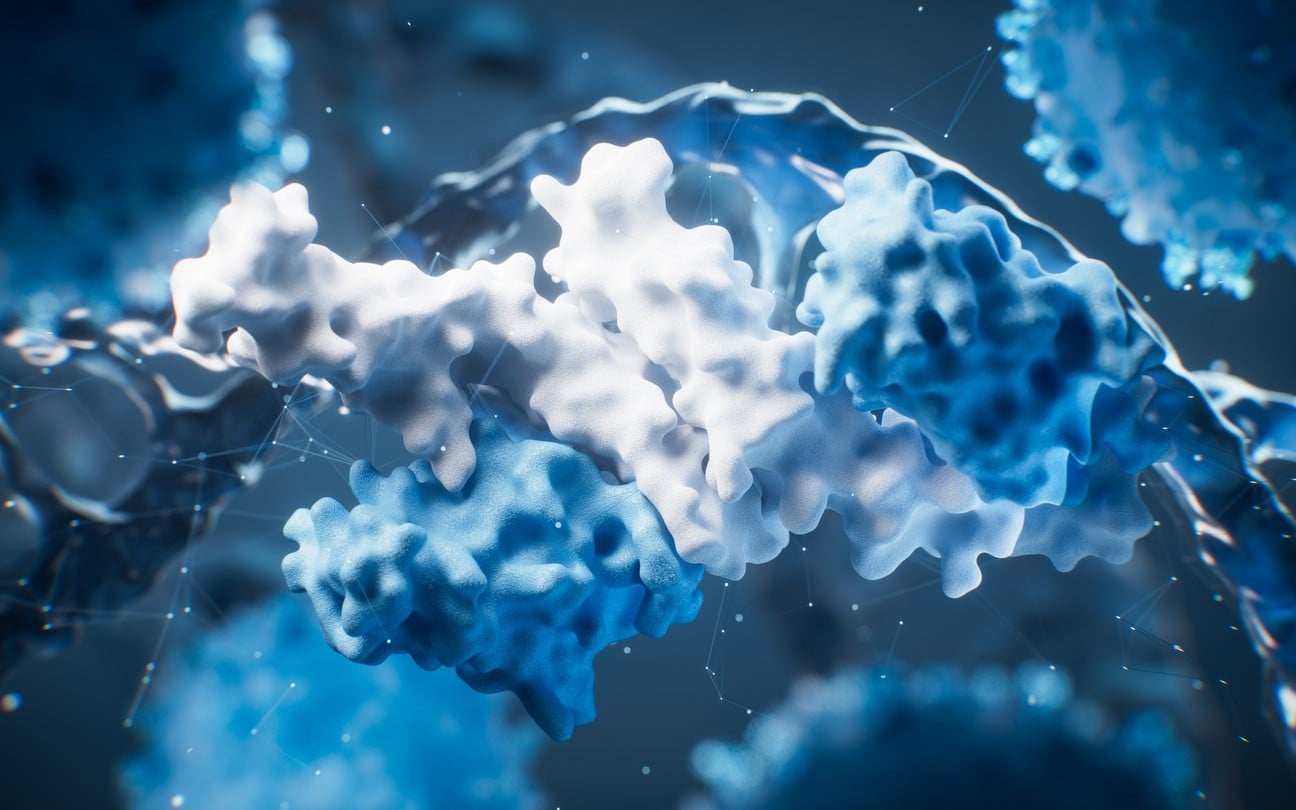
Much of the recent interest in the peptide centers on an apparent capacity to reshape how tightly chromatin is packed and, in doing so, may allow genes that were quieted by cellular age-related condensation to become accessible once more.
Research
KEDP Potential for Chromatin Remodeling and Gene Accessibility
Research suggests that KEDP is a peptide that may operate as a chromatin modifier. Chromatin is considered to be the complex assembly of DNA around histone proteins, which are believed to shift between compact and relaxed configurations, and this packing state appears to help determine which genes remain readable.
Several laboratory reports suggest that KEDP may nudge this balance toward the relaxed end of the spectrum in aged cell material. One of the most prominent investigations is that of Meskhi et al., who looked directly at the thermal behavior of chromatin drawn from lymphocytes.(1) Chromatin is posited to unfold across distinct denaturation stages as it is heated, and each stage may reflect a particular level of structural organization.
Exposure to KEDP apparently altered this thermal profile, redistributing heat between two of the observed transitions and lowering their characteristic temperatures by roughly 2.9 and 1.0 degrees Celsius. A downward shift of this kind was posited to be a sign of loosening, aka decondensation. Subtle temperature changes at the higher-order transitions further hinted at minor rearrangements at the level of nucleosome packing, which together point toward a gentle relaxation of chromatin architecture.
A separate study by Dzhokhadze examined chromosomal features in aged cell material and suggested several measurable shifts following KEDP exposure.(2) Notably, the researchers used the frequency of sister chromatid exchanges as a marker of chromosomal activity. According to the research, this marker apparently roughly doubled, moving from about 5.9 exchanges per cell in unexposed cells to around 12.0 in KEDP-exposed cells. Silver-stained nucleolus organizer regions, which are tied to ribosomal RNA gene activity, also rose from roughly 0.95 to about 2.5 per cell.
Alongside these increases, the large blocks of C-pericentromeric heterochromatin on chromosomes 1 and 9 appeared less frequently. Taken together, the authors suggested these observations as a potential sign of decondensation and deheterochromatinization under KEDP exposure. The authors also posited that the “basis for the protective action of Prostamax [may be] its modifying effect on chromatin.” According to the research of Khavinson et al. KEDP is a peptide that belongs to a group of Khavinson’s peptides that may trigger activation of ribosome genes and decondensation of tightly packed chromatin fibrils.(3)
In their experiments, KEDP specifically appeared to relax the pericentromeric structural chromatin of chromosome 1, which suggests a degree of selectivity toward particular chromosomal regions. The investigators framed this collective behavior as a possible reversal of cellular age-linked heterochromatin condensation, effectively reopening euchromatic regions that had been quieted over time.
KEDP Potential Actions on Prostate Cell Cultures
Due to its potential to reactivate condensed genes, KEDP is posited to influence reparative signaling and regulate inflammatory changes within mammalian research models. Specifically, researchers such as Zakutskiĭ et al. have investigated the potential of the peptide in prostate cell cultures.(4) The authors aimed to detect any stimulating signal that KEDP might exert on the peptide-exposed cells relative to controls.
Notably, the authors suggest that the peptide appeared to encourage growth of prostate cells, and especially aged cells. On that basis, they suggested that peptides of this class, including KEDP, may possess a potential “for the stimulation of reparative processes in the appropriate tissues while [these tissues are] aging.”
Further research by Borovskaya et al. turned to a model of chronic aseptic inflammation of the mammalian prostate cell culture, in which the cells were subjected to a procedure meant to provoke persistent inflammation.(5) When the mammalian research models were exposed to KEDP, the peptide apparently reduced several hallmarks of the inflammatory setting, including cellular swelling, vascular congestion, and lymphoid cell infiltration.
The researchers commented that beyond apparently dampening the acute changes, KEDP also seemed to limit the progression toward sclerotic and atrophic outcomes, which are the fibrotic and shrinkage-related complications that such models tend to develop. This protective potential reportedly looked more pronounced than that of the comparator agents.
NOTE: These products are intended for laboratory research use only. This peptide is not intended for personal use. Please review and adhere to our Terms and Conditions before ordering.
References:
- Meskhi T, Khachidze D, Barbakadze Sh, Madzhagaladze G, Gorgoshidze M, Monaselidze D, Lezhava T, Tadumadze N. Vliianie peptidnogo bioreguliatora prostamaksa na geterokhromatin limfotsitov cheloveka in situ [The influence of the peptide bioregulator prostamax on heterochromatin of human lymphocytes in situ]. Biofizika. 2004 Nov-Dec;49(6):1091-3. Russian. PMID: 15612551.
- Dzhokhadze TA, Buadze TZh, Gaĭozishvili MN, Baratashvili NA, Lezhava TA. [Deheterochromatinization of the chromatin in old age induced by oligopeptide bioregulator (Lys-Glu-Asp-Pro)]. Georgian Med News. 2012 Nov;(212):76-82. Russian. PMID: 23221144.
- Khavinson VKh, Lezhava TA, Malinin VV. Effects of short peptides on lymphocyte chromatin in senile subjects. Bull Exp Biol Med. 2004 Jan;137(1):78-81. PMID: 15085253. https://doi.org/10.1023/b:bebm.0000024393.40560.05
- Zakutskiĭ AN, Chalisova NI, Ryzhak GA, Aniskina AI, Filippov SV, Zeziulin PN. [The tissue-specific effect of synthetic peptides-biologic regulators in organotypic tissues culture in young and old rats]. Adv Gerontol. 2006;19:93-6. Russian. PMID: 17152728.
- Borovskaya TG, Pakhomova AV, Vychuzhanina AV, Poluektova ME, Fomina TI, Ermolaeva LA, et al. Experimental studying of the drug efficiency Prostamax in the therapy of chronic aseptic prostatitis and its complications. Modern Research in Inflammation. 2013.